
How to Break an SEO Project into Phases
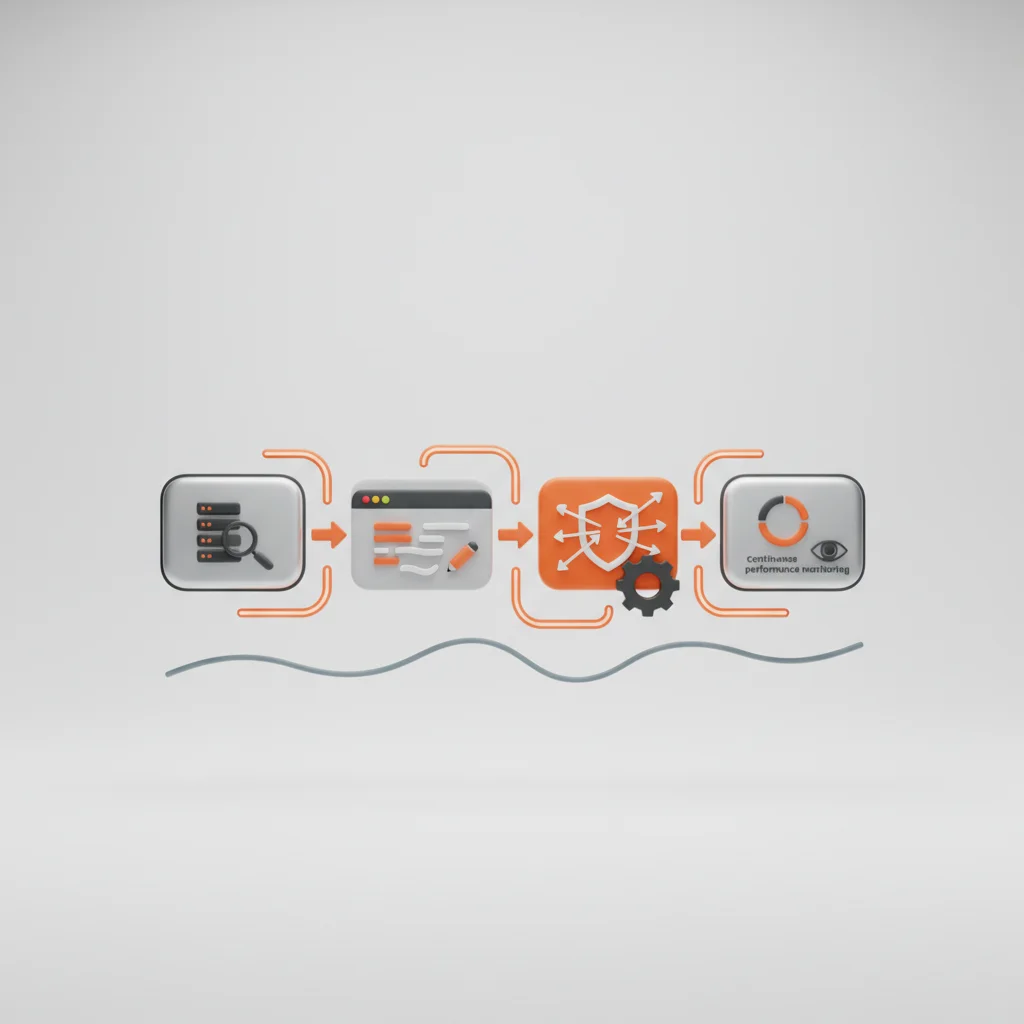
An SEO project workflow is structured into systematic phases: technical discovery, content optimization, authority building, and continuous performance monitoring.
ON THIS PAGE
0% read
- Why Phasing an SEO Project Is Crucial for Predictable Organic Growth
- Phase 1: Technical Discovery and Infrastructure Health
- Phase 2: Search Intent Alignment and Content Optimization
- Phase 3: Authority Building, Digital PR, and Off-Page Strategy
- Phase 4: Continuous Performance Monitoring, GEO Adaptation, and Iteration
- Structuring a Realistic SEO Timeline Across 6 to 12 Months
- Essential Toolstack and Governance for Multi-Phase Execution
An SEO project workflow is structured into systematic phases: technical discovery, content optimization, authority building, and continuous performance monitoring.
Breaking an organic search initiative into distinct, sequential stages transforms an overwhelming list of optimizations into a manageable, measurable, and revenue-driven roadmap. Many organic growth campaigns underperform because teams attempt to produce content, build backlinks, and fix server issues simultaneously without establishing a solid technical baseline. Understanding how to break an SEO project into phases enables business owners, marketing leaders, and digital strategists to prioritize high-impact bottlenecks, allocate technical resources efficiently, and establish clear accountability across cross-functional teams. This operational framework details every milestone—from initial crawl diagnostics and semantic keyword mapping to digital PR campaigns and algorithmic governance.
Why Phasing an SEO Project Is Crucial for Predictable Organic Growth
Executing an organic search campaign without a phased architecture is one of the primary reasons enterprise and mid-market SEO campaigns fail. When engineering, editorial, and PR teams pull in disparate directions without a unified sequencing model, resources are wasted optimizing pages that search engines cannot properly index or render. Phase-based project design enforces a disciplined operational hierarchy: solve foundational infrastructure blockers first, layer topical relevance on accessible URLs second, amplify domain authority third, and continuously measure incremental business value throughout the entire lifecycle.
A structured roadmap also resolves the persistent challenge of managing executive and stakeholder expectations. Organic search is inherently a compounding, medium-to-long-term marketing channel; expecting revenue growth within weeks of launching an un-audited website creates friction. Phasing translates abstract SEO tasks into tangible milestones with distinct definitions of done. When leadership understands that the initial 30 to 60 days focus strictly on crawling remediation and information architecture, conversations shift from speculative ranking targets to verified engineering deliverables and technical health scores.
From a budgeting and resource allocation perspective, a multi-phase framework prevents cost inflation. Deploying high-cost content production campaigns or investing in high-tier digital PR while a website suffers from canonical duplication, orphan pages, or severe Core Web Vitals degradation yields a poor return on investment. By systematically clearing technical debt before scaling external signals, every dollar invested in content and authority works within a friction-free ecosystem where search engine crawlers and generative retrieval models can seamlessly parse and index your topical authority.
Managing Stakeholder Expectations and Establishing Governance
Stakeholder friction in organic search projects almost always stems from a mismatch between effort velocity and indexation lag. Web crawlers do not discover, render, evaluate, and rank web pages instantaneously. An enterprise website with millions of URLs may require weeks or months of crawl budget reallocation before architectural changes reflect in search engine result pages (SERPs). Phasing creates distinct milestone gates where leading indicators (crawl error reduction, indexation coverage, log file request volume) demonstrate progress long before lagging indicators (qualified demo requests, pipeline contribution, revenue) materialize.
Establishing governance requires defining clear RACI matrices (Responsible, Accountable, Consulted, Informed) across departments. Developers need explicit Jira tickets with clear acceptance criteria for server responses and structured data schemas. Content creators require topical briefs backed by search intent classification rather than vague keyword suggestions. Executive sponsors need high-level dashboard summaries tracking organic visibility indices and conversion progression. When every stakeholder understands what phase the organization is operating in, interdepartmental bottlenecks dissolve.
Prioritizing High-Impact Technical and Content Bottlenecks
Not all SEO issues carry equal weight. A missing meta description on an auxiliary page has a negligible impact on revenue, whereas a misconfigured robots.txt disallow rule, rogue noindex directives, or cascading JavaScript execution errors can decimate an entire enterprise domain's organic footprint. Phased prioritization relies on an impact-versus-effort matrix that separates existential blockers from marginal enhancements.
During initial stages, high-impact foundational fixes take absolute precedence. These include eliminating redirection loops, consolidating split equity from fragmented protocol versions (HTTP vs. HTTPS), rectifying faulty hreflang implementations across international markets, and ensuring primary content renders in the raw HTML payload. Content tasks in early phases focus on high-intent conversion pages rather than top-of-funnel informational blog posts, ensuring that early ranking gains translate directly into commercial value.
Resource Allocation, Budget Modeling, and Risk Mitigation
Budgeting for an organic search program requires balancing fixed engineering overhead against variable creative and outreach costs. Phasing allows financial decision-makers to scale investment proportionally to verified performance milestones. In Phase 1, capital is primarily concentrated in specialized technical audits, log file analysis tools, and engineering sprint hours. Once technical stability is established, capital seamlessly transitions toward editorial resources, expert subject matter contributors, and digital PR outreach.
Risk mitigation is embedded directly within sequential phasing. Performing major architectural migrations, content overhauls, and mass URL redirects simultaneously exposes an organization to catastrophic algorithmic penalties or indexing drops if an error occurs. By staging migrations in controlled batches—auditing the staging environment, validating canonical tags, deploying in off-peak windows, and monitoring real-time server log data—teams isolate variables and rectify anomalies before they compromise organic revenue streams.
---
Phase 1: Technical Discovery and Infrastructure Health
Technical discovery is the bedrock of any serious organic search program. If search engine user agents cannot systematically crawl, parse, render, and index your digital assets, all subsequent investments in content marketing, digital PR, and on-page optimization are effectively neutralized. Phase 1 evaluates the entire mechanical health of the website, uncovering hidden server bottlenecks, rendering discrepancies, indexation traps, and architectural fragmentation that hinder organic performance across global search platforms and generative AI retrieval engines.
A proper technical discovery phase goes far beyond automated single-click SaaS audits. It involves rigorous data consolidation combining cloud crawls, JavaScript rendering simulations, real user monitoring (RUM) metrics, server log file extractions, and Google Search Console API exports. By cross-referencing server-side log requests with crawl data, technical architects identify crawl budget waste, such as search engine bots spending disproportionate resources crawling infinite URL parameter spaces or faceted filters while high-margin category pages remain under-crawled.
Addressing technical discovery as an isolated, rigorous milestone ensures that subsequent content publishing occurs on an optimized, fast, and fully accessible domain. During this phase, engineering teams resolve rendering bottlenecks caused by client-side JavaScript hydration delays, optimize server response times across distributed global CDNs, configure accurate XML sitemap protocols, and establish structured data foundations that explicitly define corporate entities within knowledge graphs.
Comprehensive Crawl Diagnostics and Indexability Audits
Crawl diagnostics require simulating user agent behaviors across various rendering environments. Using enterprise crawling tools, technical teams execute full JavaScript renders to compare raw HTML responses against the rendered Document Object Model (DOM). Discrepancies between these states often reveal critical elements—such as navigation menus, canonical tags, or structured data—that fail to render before client-side scripts time out, rendering them invisible to search engines that defer secondary execution passes.
Indexability audits meticulously assess HTTP response headers, canonical declarations, robots metadata directives, and XML sitemaps. A common corporate vulnerability is canonical fragmentation, where parameterized tracking URLs, staging subdomains, or paginated series point to conflicting canonical targets, diluting link equity across duplicate variants. Technical architects must verify that every index-critical URL returns a clean 200 OK status, resides within a structured sitemap hierarchy, and contains unambiguous, self-referential canonical tags unless explicitly designed as a variant.
+-------------------------------------------------------------------------+
|                    TECHNICAL DISCOVERY AUDIT MATRIX                     |
+----------------------+--------------------+-----------------------------+
| Audit Dimension      | Verification Tool  | Core Remediation Target     |
+----------------------+--------------------+-----------------------------+
| Rendering & DOM      | Custom Crawl / JS  | Eliminate client-side DOM   |
| Discrepancies        | Rendering Mode     | differences in links & tags |
+----------------------+--------------------+-----------------------------+
| Server Response &    | Log File Analyzer  | Reduce crawl waste on       |
| Crawl Efficiency     | & CDN Edge Logs    | faceted URLs; 200 OK ratio  |
+----------------------+--------------------+-----------------------------+
| Canonical & Robots   | Google Search      | Eradicate accidental        |
| Configuration        | Console API        | noindex, redirect loops     |
+----------------------+--------------------+-----------------------------+
| Core Web Vitals      | PageSpeed Insights | Sub-2.5s LCP, sub-200ms     |
| (RUM & Field Data)   | & Chrome UX Report | INP, sub-0.1 CLS            |
+----------------------+--------------------+-----------------------------+
Core Web Vitals, Rendering Performance, and Server Response
Page experience and loading speed are structural prerequisites for both organic ranking performance and user conversion rates. The Core Web Vitals framework evaluates three distinct user-centric performance metrics: Largest Contentful Paint (LCP), Interaction to Next Paint (INP), and Cumulative Layout Shift (CLS). In Phase 1, performance engineering focuses on field data aggregated via the Chrome User Experience Report (CrUX) rather than purely relying on isolated synthetic lab scores.
Optimizing LCP below the recommended 2.5-second threshold often requires re-architecting critical rendering paths: preloading hero image assets, serving modern image compression formats (AVIF/WebP), implementing responsive srcset attributes, and utilizing edge caching to minimize Time to First Byte (TTFB). For INP, JavaScript main thread blocking must be reduced by breaking up long tasks, deferring non-critical third-party tag management scripts, and optimizing event listeners. CLS stability demands explicit width and height dimensions on all layout elements, reserved ad spaces, and avoiding late-injected dynamic UI banners.
Information Architecture, Faceted Navigation, and Internal Linking
Information architecture (IA) dictates how search engines and visitors navigate through a website's topic universe. A shallow, logical click depth—where high-priority commercial and educational URLs reside within three clicks of the root domain—ensures equitable distribution of PageRank and link equity. Phase 1 audits identify orphan pages (URLs with zero incoming internal links) and dead ends, restructuring the taxonomy to reinforce thematic relevance through parent-child breadcrumb hierarchies.
Faceted navigation in large e-commerce or directory platforms presents significant crawl budget and indexation risks. Millions of combinations generated by price, color, and size filters can trigger infinite crawl spaces. Technical teams must implement strict parameter handling rules using robots.txt disallows, noindex robots meta tags, or server-side URL routing to ensure only commercially viable facet combinations (such as high-volume category and brand intersections) are indexed while purely functional filters remain crawl-restricted.
---
Phase 2: Search Intent Alignment and Content Optimization
Once the technical foundation is stable and verified, Phase 2 shifts focus toward content optimization, semantic relevance, and search intent alignment. Publishing generic, keyword-stuffed articles no longer succeeds in modern search ecosystems powered by natural language processing (NLP), semantic embeddings, and machine learning models. Content must be systematically mapped against the exact expectations of searchers across every stage of the buyer's journey—from early problem discovery to final commercial evaluation.
This phase is not merely about writing new copy; it begins with a comprehensive audit of existing content assets. Many established websites suffer from keyword cannibalization, where multiple legacy URLs compete for identical queries, diluting domain authority and confusing search engines regarding which page to surface. Phase 2 conducts rigorous content pruning, consolidation, and 301 redirection workflows to transform fragmented, thin pages into authoritative, comprehensive topic clusters that demonstrate unmistakable subject matter expertise.
Furthermore, content optimization must cater to modern generative search interfaces, such as Google AI Overviews and conversational answer engines. Content must feature structured data, concise informational definitions, extractable data tables, and authoritative factual assertions that algorithms can reliably parse as reference citations. Developing comprehensive topical authority requires covering parent concepts and all logically associated sub-topics, entities, edge cases, and practical implementation frameworks.
Keyword Mapping, Topic Clustering, and Search Intent Classification
Effective keyword mapping eliminates guesswork by assigning target primary queries, secondary long-tail variations, and semantic entities to specific, dedicated URLs. Search queries must be rigorously categorized into their primary intent profiles: informational (seeking answers or tutorials), commercial investigation (comparing vendors, reading reviews), transactional (ready to purchase or book a demo), or navigational (locating a specific brand portal). Misaligning intent—such as targeting a purely transactional keyword with a 4,000-word academic guide—leads to high bounce rates and suppressed rankings.
Topic clustering organizes content into a hub-and-spoke architecture. The hub page (pillar) provides an authoritative, high-level overview of a broad subject, while surrounding cluster pages (spokes) delve deeply into specific sub-topics, implementation steps, and niche questions. Hyperlinking all spoke pages back to the primary pillar using descriptive, exact-match or partial-match anchor text reinforces the domain's topical authority and creates intuitive navigation pathways for both search bot crawlers and prospective customers.
Systematic Content Gap Analysis Across Competitive SERPs
Content gap analysis identifies strategic opportunities where top-ranking market competitors capture organic demand that your website fails to address. By utilizing competitive intelligence databases and scraping SERP feature layouts, content strategists isolate high-value subject clusters where the domain lacks topical coverage. This involves analyzing competitor headings, schema implementations, featured snippet ownership, and user discussion forums to understand where market coverage is incomplete.
Beyond simple keyword presence, gap analysis evaluates structural content depth:
Are competitors providing interactive calculators, downloadable templates, or proprietary frameworks?
Are current top-ranking results failing to answer common follow-up questions present in "People Also Ask" modules?
Does the existing content provide first-hand practitioner perspectives, original data points, and transparent methodologies that satisfy Experience, Expertise, Authoritativeness, and Trustworthiness (E-E-A-T) benchmarks?
Addressing these structural gaps with superior depth, clearer typography, and verified real-world examples allows new or refreshed pages to outrank established competitors.
+--------------------------------------------------------------------------+
|                  CONTENT GAP & INTENT EXECUTION MATRIX                   |
+----------------------+--------------------+------------------------------+
| Intent Category      | SERP Features      | Optimized Content Asset Type |
+----------------------+--------------------+------------------------------+
| Informational / GEO  | AI Overviews, PAA, | Comprehensive Pillar Guides, |
| Definition           | Featured Snippets  | Glossaries, Quick Definitions|
+----------------------+--------------------+------------------------------+
| Commercial           | Comparison Tables, | "Best vs.", Versus Matrices, |
| Investigation        | Review Carousels   | Buyer Checklists, Teardowns  |
+----------------------+--------------------+------------------------------+
| Transactional /      | Local Packs, Rich  | Conversion Landing Pages,    |
| Direct Purchase      | Product Snippets   | Solutions Pages, Demos       |
+----------------------+--------------------+------------------------------+
| Navigational & Brand | Sitelinks, Brand   | Brand Resource Portals,      |
| Entity               | Knowledge Panels   | Corporate Documentation Hubs |
+----------------------+--------------------+------------------------------+
On-Page SEO Execution, Semantic Entity Integration, and UX Signals
On-page execution transforms keyword strategies into published code and copy. Every page must feature an optimized semantic hierarchy: a single, descriptive H1 tag containing the primary topic, structured H2 subheadings addressing core concepts, and nested H3 tags covering specific micro-intentions. Meta titles must balance keyword inclusion with compelling click-through rate (CTR) triggers, while meta descriptions provide concise, benefit-driven summaries that entice organic clicks.
Modern on-page optimization heavily incorporates semantic entity integration. Search engines understand topics as a web of interconnected entities (people, places, concepts, technologies) rather than isolated text strings. Integrating related technical terminology, industry standards, and relevant Schema.org markup (such as Article, FAQPage, Product, or Organization) clarifies the precise context of the page within the wider semantic web. Furthermore, readable layouts—incorporating generous white space, visual breakouts, and actionable bullet points—reduce bounce rates and increase session duration, sending positive user engagement signals back to ranking algorithms.
---
Phase 3: Authority Building, Digital PR, and Off-Page Strategy
A technically flawless website with exceptional content will still struggle in competitive SERPs without external validation. Phase 3 focuses on building domain authority, establishing brand equity, and earning high-quality backlinks from recognized, contextually relevant industry publications. Backlinks function as algorithmic endorsements; when reputable third-party websites consistently cite your research, guides, or products, search engines infer that your domain is a trusted authority deserving of premier ranking placement.
Off-page strategy in modern organic search has evolved far beyond automated directory submissions, private blog networks (PBNs), or indiscriminate guest blogging. Search engine quality algorithms penalize unnatural link patterns and ignore low-tier, spam-heavy link farms. Phase 3 emphasizes editorial digital PR: creating original industry research reports, proprietary surveys, interactive tools, and data-driven whitepapers that naturally attract journalists, industry commentators, and niche bloggers looking for authoritative primary sources to cite.
Furthermore, off-page authority encompasses entity validation across the broader digital landscape. Search engines evaluate brand search volume, unlinked brand mentions in major media outlets, executive social footprints, and corporate profiles on platforms like Wikidata, Crunchbase, and leading industry review directories (such as G2, Capterra, or Trustpilot). Unifying these off-page signals reinforces your brand’s presence within the global Knowledge Graph, shielding your organic rankings against routine algorithmic turbulence.
Backlink Quality Audits and Toxic Risk Remediation
Before launching proactive link acquisition campaigns, teams must thoroughly evaluate historical backlink profiles. Websites that engaged in aggressive, manipulative link building in past years may carry latent algorithmic suppression. Backlink audits classify referring domains based on topical relevance, Domain Rating/Authority metrics, organic traffic volume, and anchor text distribution profiles.
An over-optimized anchor text profile—where an unnatural percentage of external links use exact commercial keywords rather than branded variations or organic URLs—presents a major vulnerability. Audits identify spam-laden domains, scraper networks, and irrelevant foreign language link bursts. While search algorithms largely ignore low-quality links automatically, filing a manual disavow file remains an essential corrective action for domains carrying historical manual actions or facing severe algorithmic quality penalties.
Editorial Outreach, Digital PR, and Unlinked Brand Mentions
Sustainable link acquisition relies on producing linkable assets that solve genuine industry data gaps. Developing annual benchmark reports, publishing proprietary user survey statistics, and releasing open-source developer toolkits serve as natural link magnets. Digital PR teams pitch these unique findings to journalists, trade publications, and tech editors through personalized, value-first media outreach campaigns.
Another efficient off-page tactic is reclaiming unlinked brand mentions. Established enterprises and high-growth brands are frequently referenced in industry news, podcast show notes, and market analysis roundups without an active hyperlink. Using brand monitoring tools, outreach specialists identify these editorial mentions, contact the publishing editors, express appreciation for the coverage, and politely request that the reference be hyperlinked to the original source or research landing page.
+--------------------------------------------------------------------------+
|                  AUTHORITY BUILDING TACTICAL FRAMEWORK                   |
+----------------------+---------------------+-----------------------------+
| Outreach Tactic      | Target Media        | Primary Core Asset          |
+----------------------+---------------------+-----------------------------+
| Data-Driven          | Mainstream Tech &   | Proprietary Industry Survey |
| Digital PR           | Industry Journalists| or Economic Benchmark Index |
+----------------------+---------------------+-----------------------------+
| Unlinked Brand       | Trade Blogs, Event  | Existing Editorial Brand    |
| Reclamation          | Portals, Podcasts   | Citations & Press Releases  |
+----------------------+---------------------+-----------------------------+
| Thought Leadership   | High-Tier Niche     | Contributed Expert Op-Eds,  |
| / Guest Placement    | Publications        | Original Research Analyses  |
+----------------------+---------------------+-----------------------------+
| Resource & Tool      | University Portals, | Free Calculators, APIs, or  |
| Page Link Building   | Trade Associations  | Definitive Category Guides  |
+----------------------+---------------------+-----------------------------+
Local Signals, Entity Validation, and Topical Footprint Expansion
For organizations operating physical storefronts, service areas, or regional sales offices, off-page authority must incorporate local signals. This requires auditing and standardizing Name, Address, and Phone number (NAP) citations across primary data aggregators (Localeze, Foursquare, Data Axle) and prominent local business directories. Inconsistencies in regional contact details dilute geographic search engine confidence and lower visibility in Google Local Map Packs.
Entity validation extends into digital knowledge graphs. Ensuring that your organization has fully populated, consistent profiles across Google Business Profile, LinkedIn, Wikipedia/Wikidata (if eligible), and reputable industry review ecosystems reinforces brand legitimacy. These structured digital footprints provide search engines with unambiguous proof that your business is an authenticated, legally registered, and actively operating enterprise.
---
Phase 4: Continuous Performance Monitoring, GEO Adaptation, and Iteration
SEO is not a one-time project with a fixed endpoint; it is an ongoing, compounding operational program. Once technical infrastructure, optimized content, and domain authority are established, Phase 4 transitions the initiative into a continuous optimization, performance monitoring, and algorithmic adaptation lifecycle. Search algorithms update constantly, competitors launch aggressive counter-strategies, and user search behavior evolves rapidly alongside artificial intelligence technologies.
Continuous monitoring prevents the gradual decay of organic visibility. Pages that ranked #1 twelve months ago can slowly lose ground as new competitors enter the market or as freshness algorithms prioritize more recently updated sources. Phase 4 establishes systematic content refresh cadences, conversion rate optimization (CRO) testing across high-traffic landing pages, and ongoing crawl audits to catch new technical regressions introduced during routine software engineering deployments.
Furthermore, Phase 4 actively incorporates Generative Engine Optimization (GEO). As generative AI overviews and conversational discovery engines (such as ChatGPT Search, Perplexity, and Google AI Overviews) capture traditional click-through traffic, monitoring brand presence within synthetic answers becomes vital. Organizations must track citation frequency within AI-generated responses, monitor conversational prompt variations, and optimize information architecture to ensure brand messaging is accurately synthesized by generative neural models.
Establishing Leading and Lagging KPIs in GA4 and Search Console
Measuring organic search performance requires distinguishing between leading indicators (metrics that signal future momentum) and lagging indicators (metrics that reflect historical financial output). Relying solely on lagging revenue metrics can cause premature panic or misguided strategy shifts during the early months of a campaign when search engines are still recalibrating domain authority.
Essential measurement framework:
Leading KPIs: Total impression volume in Google Search Console, keyword rankings entering the top 20 and top 10 positions, indexation velocity of newly published URLs, average position improvements on primary topic clusters, and crawl frequency observed in server logs.
Lagging KPIs: Qualified organic sessions, newsletter signups, marketing-qualified leads (MQLs), pipeline value generated from organic touchpoints, and total realized revenue attributed via multi-touch attribution models in Google Analytics 4 (GA4).
Custom Looker Studio dashboards should integrate GSC API data with GA4 conversion funnels, enabling stakeholders to inspect organic conversion paths from initial landing page to ultimate contract signing.
Algorithmic Shift Audits and Generative Engine Optimization (GEO)
Core algorithm updates can disrupt SERP layouts overnight. Phase 4 governance involves monitoring industry volatility trackers and executing immediate post-update impact assessments whenever major algorithmic updates occur. If organic visibility drops following an update, teams must avoid making impulsive, domain-wide changes. Instead, perform an objective gap analysis: Did the update target thin affiliate content, unverified medical/financial advice, slow-loading mobile pages, or over-optimized anchor text profiles?
Adapting to Generative Engine Optimization requires a structural shift in how information is presented:
Direct Answer Syntax: Place unambiguous, declarative answers at the beginning of informational sections so LLMs can easily lift snippets.
Entity Consistency: Maintain unified brand facts, executive bios, and product specifications across all digital channels to prevent AI hallucinations.
Structured Quotations and Citations: Integrate verified statistics, original research, and named expert quotes that generative models reference when citing primary authorities.
Iterative Testing, Conversion Rate Optimization, and Content Refreshes
Organic traffic that fails to convert into pipeline is a squandered operational investment. Phase 4 continuously pairs SEO with Conversion Rate Optimization (CRO). By analyzing heatmaps, scroll maps, and session recordings on high-traffic organic landing pages, marketing teams identify UX drop-off points. Optimizing call-to-action (CTA) placements, simplifying contact forms, improving mobile readability, and incorporating contextual social proof (customer logos, case studies) turns passive organic readers into active commercial prospects.
Simultaneously, a structured content refresh calendar must be enforced. Every 6 to 12 months, existing high-performing articles should be audited to replace outdated statistics, update broken internal and external links, add newly emerged sub-topics, and improve visual assets. Content pruning should also be executed: identifying legacy URLs that attract zero traffic and zero backlinks, then either deleting them with a 410 Gone status or consolidating them into relevant master pillar pages via 301 redirects.
---
Structuring a Realistic SEO Timeline Across 6 to 12 Months
A realistic timeline prevents organizational frustration and aligns executive sponsors with the true mechanics of search engine indexation. While pay-per-click advertising offers instantaneous visibility at a recurring cost, organic search behaves like an investment portfolio: it requires upfront capital expenditure to build assets, after which it yields compounding, highly defensible organic returns with zero incremental cost-per-click.
The timeline below illustrates how the four core phases translate into operational quarters. Depending on domain age, historical technical debt, engineering velocity, and competitive intensity, execution timelines may vary. However, attempting to compress this timeline without resolving underlying dependencies almost universally results in wasted spend and volatile ranking outcomes.
A practical chronological progression from initial audit to compounding market leadership. Execute full-site crawl diagnostics, server log analysis, Google Search Console cleanup, Core Web Vitals profiling, and initialize low-hanging technical quick wins. Resolve high-impact engineering blockers, establish topic cluster taxonomies, fix canonical/indexation flaws, and launch on-page refreshes for high-intent commercial URLs. Scale regular production of topic cluster spokes, launch proprietary digital PR research campaigns, acquire authoritative editorial backlinks, and conduct first-pass CRO tests. Monitor leading and lagging KPIs, adapt content for generative engine citations, execute systematic content refreshes, prune underperforming URLs, and expand into adjacent keyword verticals.Strategic 12-Month SEO Roadmap
Month 1: Discovery, Audit & Foundational Setup
Months 2 to 3: Core Remediation & Content Architecture
Months 4 to 6: Content Scaling & Digital PR Amplification
Months 7 to 12+: Expansion, GEO Optimization & Compounding Loops
+--------------------------------------------------------------------------+
|                    12-MONTH SEO TIMELINE & DELIVERABLES                  |
+-------------+-----------------------------+------------------------------+
| Timeframe   | Primary Operational Focus   | Expected Tangible Output     |
+-------------+-----------------------------+------------------------------+
| Month 1     | Technical discovery, crawl  | Full technical audit report, |
|             | audits, GA4/GSC baseline    | Jira tickets, low-effort wins|
+-------------+-----------------------------+------------------------------+
| Months 2-3  | Architectural fixes, intent | Pruned URLs, refreshed core  |
|             | mapping, commercial on-page | pages, clean sitemap/robots  |
+-------------+-----------------------------+------------------------------+
| Months 4-6  | Content cluster scaling,    | Net new topic hubs published,|
|             | digital PR data outreach    | editorial backlinks earned   |
+-------------+-----------------------------+------------------------------+
| Months 7-12 | Performance iteration, GEO  | Measurable MQL/revenue lift, |
|             | optimization, CRO testing   | market leadership in SERPs   |
+-------------+-----------------------------+------------------------------+
---
Essential Toolstack and Governance for Multi-Phase Execution
Executing an enterprise-grade, multi-phase SEO roadmap is impossible without the proper technology stack. Specialized software is required at every milestone to extract diagnostic data, evaluate competitor footprints, map keyword entities, and track user journeys through conversion funnels. Choosing the right toolset prevents analytical silos and ensures that engineering, product, and content teams operate from a single source of truth.
Software tools alone, however, do not generate organic growth. Organizations must establish rigorous project governance: translating raw tool outputs into prioritized development tickets, editorial briefs, and executive reporting summaries. Without clear governance and cross-departmental alignment, SEO tools quickly turn into expensive shelfware that produces automated audit reports without driving tangible engineering deployments.
Technical Auditing and Crawling Platforms
Technical discovery and ongoing site health monitoring rely on dedicated crawling engines. Desktop crawlers like Screaming Frog SEO Spider and Sitebulb provide deep diagnostic flexibility, allowing technical architects to execute custom JavaScript rendering passes, extract custom regex data, audit structured data schemas, and visualize internal link architecture.
For enterprise domains containing hundreds of thousands or millions of URLs, cloud-based auditing platforms such as Botify, Deepcrawl (Lumar), and OnCrawl are indispensable. These platforms handle massive crawling volumes without local hardware constraints and integrate directly with CDN edge servers (Cloudflare, Fastly, Akamai) and server log files, providing real-time visibility into search bot crawl efficiency and server performance.
Intent Intelligence, Competitive SERP Analytics, and Keyword Databases
Content optimization and competitive gap analysis demand robust market intelligence databases. Platforms such as Ahrefs and Semrush provide expansive databases of historical search queries, backlink profiles, SERP feature compositions, and competitor market share estimations. They enable teams to track keyword ranking distributions across international locales and evaluate the search volume trajectories of specific industry topics.
For granular semantic intent analysis and natural language processing optimization, tools like Surfer SEO, Clearscope, and MarketMuse evaluate top-ranking SERP competitors to identify semantic entity gaps, optimal content length parameters, and related topical sub-headings. Utilizing these tools during Phase 2 ensures that newly authored or refreshed content matches the topical depth expected by search engine evaluation models.
Project Management Software and Cross-Functional Workflows
The ultimate failure point of many SEO initiatives is the execution gap: audits are delivered as static PDF documents that sit unread in marketing inboxes while developers remain focused on core product sprints. Bridging this gap requires embedding organic search tasks directly into enterprise project management software such as Jira, Asana, ClickUp, or Monday.com.
SEO strategists must translate diagnostic findings into standard engineering user stories with precise acceptance criteria. For example, rather than creating a generic ticket stating "Fix Core Web Vitals," an actionable Jira issue specifies: "Preload the LCP hero image asset on category template URLs and defer loading of third-party tracking scripts until window onload." Assigning clear story points, sprint milestones, and automated QA validation tests ensures technical SEO tickets move through developer pipelines alongside primary product releases.
---
Frequently Asked Questions
What is the single most critical phase of an SEO project?
Phase 1 (Technical Discovery) is the most critical foundation because search engines must be able to crawl, render, and index URLs before content or backlinks can provide value.
How do you measure success during the early phases before traffic increases?
Early success is evaluated using leading indicators such as crawl error reduction, improved Core Web Vitals, indexation coverage in Google Search Console, and keyword movement into the top 20.
Can an organization run multiple SEO phases simultaneously?
While preliminary keyword research can begin during technical audits, execution must remain sequential: fundamental technical blockers must be resolved before launching large-scale content and link campaigns.
How long does it take to see measurable business results from a phased SEO roadmap?
Measurable ranking and traffic improvements typically emerge between months 3 and 6, while compounding revenue growth and commercial market leadership generally materialize between months 6 and 12.
What is the main difference between Phase 2 content optimization and traditional copywriting?
Phase 2 content optimization aligns copy with specific search intent, topic clusters, semantic entity graphs, and technical on-page structures rather than writing broad, unstructured marketing copy.
Why is digital PR prioritized in Phase 3 rather than Phase 1?
Building high-authority backlinks to a website that has broken user journeys, slow loading speeds, or indexation errors wastes capital because the domain cannot maximize the acquired link equity.
How does Generative Engine Optimization (GEO) fit into Phase 4 monitoring?
Phase 4 monitors how conversational AI models synthesize brand facts, tracking inclusion across AI overviews and optimizing information architecture for direct machine extraction.
How often should an established website repeat the 4-phase SEO lifecycle?
Enterprise websites should treat the phases as an ongoing loop: conducting deep technical discovery annually while running content refreshes, link acquisition, and continuous monitoring every quarter.