
How to Plan SEO Work: Workstreams and Order of Execution
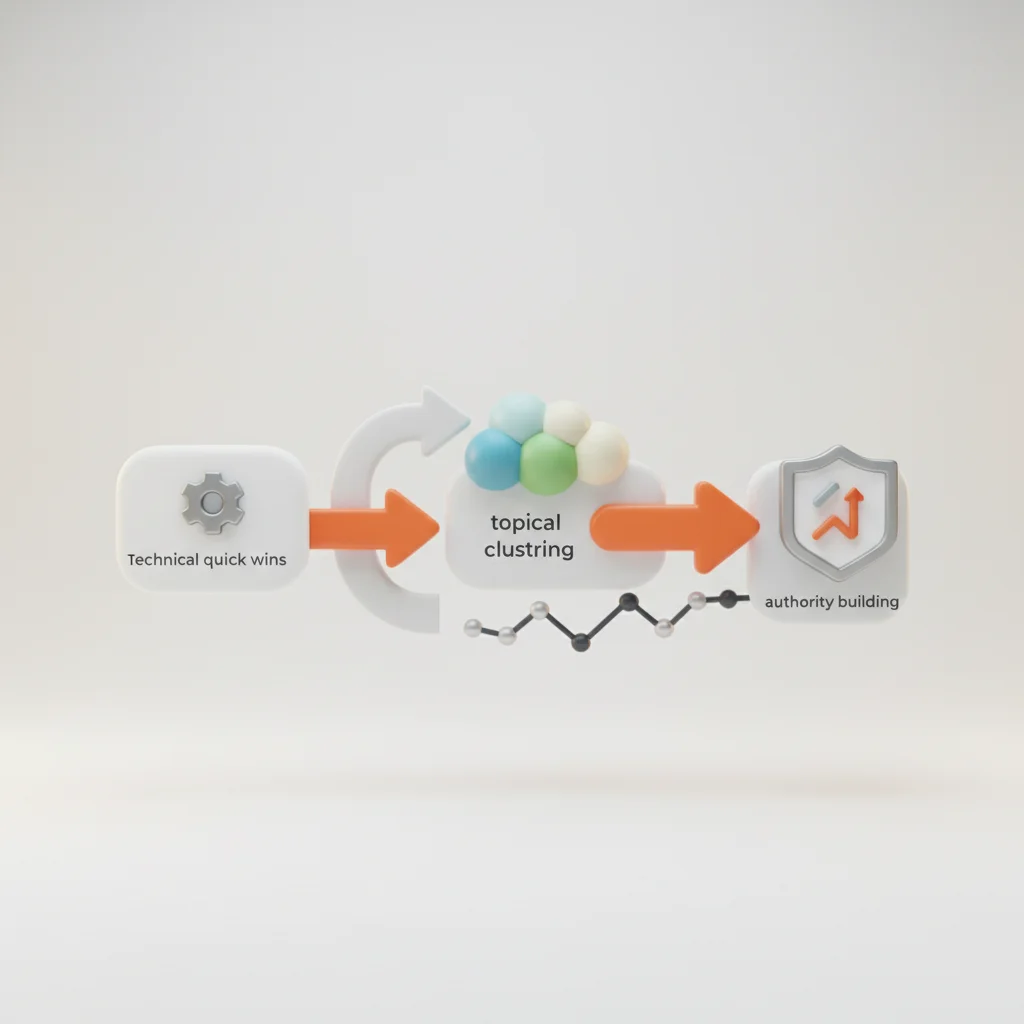
Learn to structure SEO workstreams using a logical execution order that prioritizes technical quick wins, topical clustering, and authority building for search engines.
ON THIS PAGE
0% read
- The Anatomy of Modern SEO Workstreams
- Phase 1: Securing Technical Quick Wins (Months 1-2)
- Phase 2: Topical Clustering & Content Velocity (Months 2-4)
- Phase 3: Authority Building and Off-Page Alignment (Months 4+)
- The ICE Framework: Prioritizing SEO Execution
- Maintaining Velocity in Enterprise SEO Plan Execution
Strategic organic growth requires a disciplined operational framework where technical stability, topical relevance, and brand authority are deployed in a phased sequence. Structuring an enterprise SEO roadmap around distinct workstreams prevents common resource bottlenecks, eliminates premature link acquisition on unindexed pages, and ensures every engineering sprint directly supports organic visibility and revenue generation.
Understanding how to plan SEO work: workstreams and order of execution enables business leaders, growth strategists, and technical teams to transition from reactive ticket logging to predictable organic acquisition. When search engine crawlers encounter indexation barriers, low content depth, or unverified entity signals, search engines withhold rank potential across entire subdomains. Executing search optimization in sequential workstreams ensures each layer amplifies the next.
The Anatomy of Modern SEO Workstreams
Modern search engine optimization cannot operate as a monolithic checklist. In enterprise web architectures, SaaS environments, and large-scale e-commerce platforms, organic search performance relies on three distinct, interdependent operational engines: Technical Infrastructure, Topical Content Architecture, and Authority Building. Treating these as parallel or chaotic initiatives leads to wasted engineering budgets, delayed indexation, and diluted ranking signals.
A workstream-based operational model isolates distinct competencies, tools, and cross-functional teams while establishing clear input-output dependencies. Technical SEO builds the indexable, performant infrastructure; content architecture fills this infrastructure with semantically clustered entity answers; and authority building acquires the external signals required to outrank established competitors in competitive SERP landscapes.
Technical Foundation & Infrastructure (The Enabler)
The technical infrastructure represents the foundational layer of search visibility. If search engine user-agents cannot fetch, render, parse, and index URLs efficiently, on-page content and off-page backlink investments yield zero commercial return. Technical SEO functions as an enabler by clearing bottlenecks within the critical rendering path, server response layers, and document object models.
Enterprise infrastructure planning must account for edge routing, single-page application (SPA) client-side rendering challenges, international hreflang setups, and structured data serialization. Establishing technical stability early ensures that new content assets achieve discovery within hours rather than languishing in the Google Search Console "Crawled - currently not indexed" queue for months.
Topical Authority & Content Architecture (The Engine)
Once technical barriers are resolved, the content engine manufactures organic visibility by demonstrating exhaustive domain competence. Search engines evaluate websites based on semantic topical graphs rather than isolated keyword matches. Constructing topical authority requires structuring content into logical hub-and-spoke hierarchies that cover parent topics, transactional variants, informational dependencies, and comparative user journeys.
Content architecture ensures that internal link equity flows naturally from high-volume informational guideposts to high-conversion product landing pages. Developing content without a structured thematic cluster produces fragmented pages that cannibalize one another's rankings. A systematic content workstream establishes uniform editorial criteria, entity definitions, and structured semantic markup across every published asset.
Authority Building & Digital PR (The Accelerator)
Authority building acts as the external verification layer that validates the quality and trustworthiness of your platform. External backlinks, unlinked brand citations, and digital PR placements communicate real-world authority to search engine ranking algorithms. However, off-page promotion acts strictly as an accelerator; it amplifies the underlying strength of the technical and content foundation.
Directing high-tier editorial backlinks toward poorly structured, thin, or technically broken URLs wastes digital PR outreach capital. When authority signals are channeled into deeply researched, semantically robust pillar pages, the acquired PageRank distributes downward through internal contextual links, lifting the visibility of associated commercial landing pages across the entire cluster.
Risk Assessment: The Cost of Disorganized Workstreams
Executing SEO initiatives without a logical sequence causes severe operational waste and organizational friction. The most common organizational failure is commissioning expensive content production while the CMS maintains structural indexing barriers, such as misconfigured canonical tags or restrictive robots.txt directives. In such scenarios, months of editorial budget produce zero organic indexation.
Similarly, investing in digital PR campaigns prior to securing Core Web Vitals and resolving on-page conversion friction results in acquired traffic bouncing immediately. Disorganized workstreams also strain relationships with internal software engineering teams. Submitting a 200-item unstructured audit backlog creates ticket fatigue, leading engineering leads to deprioritize SEO tickets entirely in favor of core product roadmaps.
Phase 1: Securing Technical Quick Wins (Months 1-2)
The initial sixty days of an SEO roadmap must prioritize technical stabilization and crawl path remediation. Search engines allocate finite crawl budgets and processing resources to any given hostname. When thousands of low-value, duplicate, or broken URLs occupy this crawl budget, algorithmic crawlers fail to discover updated revenue-generating pages.
Phase 1 focuses on high-impact, low-complexity interventions that directly influence indexation hygiene and page loading performance. By eliminating technical debt in the first two months, marketing leaders create a stable baseline for measuring future content and authority campaigns.
Technical Quick Wins Priority Flow:
Crawl Efficiency & Log Analysis ➔ Indexation Hygiene ➔ Critical Rendering Path & CWV ➔ Baseline Analytics
Prioritizing Indexability and Crawl Budget Issues
Indexability analysis begins by comparing the total number of valid URLs within XML sitemaps against the indexed inventory reported in Google Search Console's Page Indexation reports. Significant discrepancies signal server routing errors, rogue noindex directives, or widespread canonical mismatches.
Indexation Health Ratio = (Indexed URLs in Search Console / Total Submitted Valid Sitemap URLs) * 100
Target Benchmark: > 90% Valid Coverage
Server log file analysis must be executed during this phase to evaluate user-agent request behaviors. By parsing web server access logs (via Amazon CloudWatch, Datadog, or specialized log analyzers), technical teams identify whether search bots spend excessive bandwidth crawling faceted navigation parameters, internal search result pages, or infinite pagination loops. Rectifying these issues via robots.txt disallow rules and proper canonical headers instantly redirects crawler focus to core transactional landing pages.
Quick Wins: Resolving Redirect Loops, 404s, and Core Web Vitals
Technical debt often accumulates silently in legacy CMS installations. Resolving broken internal links, multi-hop redirect chains (e.g., HTTP ➔ HTTPS ➔ non-WWW ➔ trailing slash), and 404 response codes recovers link equity that has leaked over time.
Core Web Vitals remediation should focus primarily on site-wide template bottlenecks. Common high-impact quick wins include:
Largest Contentful Paint (LCP): Preloading hero images, serving modern formats (AVIF/WebP), and implementing strict caching policies on Content Delivery Networks (CDNs) like Cloudflare or Fastly.
Interaction to Next Paint (INP): Deferring non-essential third-party JavaScript tracking tags, breaking up long main-thread tasks, and minimizing DOM complexity.
Cumulative Layout Shift (CLS): Reserving explicit aspect-ratio dimensions for media elements, dynamic ad slots, and asynchronous banner embeds.
Setting Up Clean Performance Measurement Frameworks
Data integrity is mandatory before scaling execution. During Phase 1, analytics pipelines must be audited to ensure that organic traffic is accurately attributed without contamination from direct redirects, internal employee traffic, or cross-domain tracking drops.
Teams must establish customized Google Search Console property sets, verify URL-prefix and domain-level properties, and deploy Server-Side Google Tag Manager containers where appropriate. Furthermore, establishing rank tracking across designated semantic entity groups provides granular visibility into how specific page categories respond to technical fixes.
Cautionary Note: Avoiding the "Infinite Audit" Trap
A frequent failure mode among digital marketing teams is remaining permanently stuck in the analysis phase. Automated website audit crawlers (such as Screaming Frog, Sitebulb, or enterprise audit platforms) generate voluminous issue lists containing thousands of low-severity notices, such as missing image alt attributes on archival blog posts or minor meta description length variations.
Attempting to resolve every minor diagnostic flag before publishing content or building links stalls momentum. Engineering resources must be reserved exclusively for P0 and P1 blocking issues: canonical corruption, rendering failures, indexation blocks, duplicate site variants, and critical site speed bottlenecks.
Phase 2: Topical Clustering & Content Velocity (Months 2-4)
With the technical foundation stabilized, Phase 2 activates the content engine. Modern generative search systems, vector-based information retrieval engines, and traditional web crawlers evaluate content depth through the lens of semantic completeness. A website cannot rank consistently for high-volume commercial head terms without supporting those pages with comprehensive informational infrastructure.
Months 2 through 4 are dedicated to mapping the complete topical graph of your vertical, closing content gaps against competitors, and establishing an operational editorial sprint cadence.
Structuring Content with the Hub-and-Spoke Model
The hub-and-spoke (or pillar-and-cluster) architecture organizes website taxonomy into distinct semantic units. The central "Hub" or "Pillar" page covers a core industry entity comprehensively at a high level, targeting broad commercial and informational intent. The "Spokes" or "Cluster Pages" dissect specific sub-topics, tactical questions, implementation steps, and long-tail variants.
Hub-and-Spoke Architecture:
[ Core Category Pillar Hub ]
     ├── [ Informational Spoke: Definitions & Concepts ]
     ├── [ Technical Spoke: Implementation & Troubleshooting ]
     ├── [ Comparative Spoke: Alternatives & Frameworks ]
     └── [ Commercial Spoke: Use Cases & Solution Guides ]
Internal links within a cluster must be reciprocal and strict. Each cluster page links directly back to the pillar page using descriptive, entity-rich anchor text. Furthermore, contextual cross-links between sibling cluster pages must be implemented where logical semantic dependencies exist. This closed-loop linking architecture ensures that search bots recognize the thematic unity of the cluster, aggregating relevance and distributing authority efficiently.
Keyword Mapping to Intent: Informational vs. Commercial Workflows
Content planning often fails when editorial teams target keywords without analyzing the underlying search intent reflected in the Search Engine Results Pages (SERPs). Keyword mapping requires classifying search terms into explicit user journey stages and assigning them to the correct document templates.
Creating informational guides for transactional queries or designing featureless product pages for educational queries creates an intent mismatch. Search engines detect low engagement and rapid SERP bounces, subsequently suppressing the page. Intent-driven keyword mapping ensures that every created URL matches the exact cognitive requirement of the searcher.
Establishing Content Velocity Without Sacrificing Editorial Standards
Organic search competitiveness in enterprise verticals requires consistent publication volume, known as content velocity. Publishing two articles per month is rarely sufficient to establish topical authority against incumbent competitors holding thousands of indexed pages. Organizations must build scalable content supply chains.
Achieving high velocity without degrading editorial quality requires a modular production workflow:
Strategic Content Briefs: Comprehensive outlines created by SEO strategists detailing required entities, semantic LSI terms, user questions, internal link targets, and structured data schemas.
Subject Matter Expert (SME) Input: Incorporating primary research, proprietary data, practitioner quotes, and unique technical insights that generative models cannot replicate.
Editorial Governance & Review: Fact-checking, brand voice compliance, code validation (for technical guides), and original media creation.
Cautionary Note: Preventing Keyword Cannibalization in Early Phases
When ramping up content velocity, teams frequently create overlapping articles that compete for identical keyword clusters. Keyword cannibalization occurs when search engine algorithms cannot determine which URL is the canonical authority for a given query, resulting in fluctuating ranks, split link equity, and suppressed impressions across both pages.
To prevent cannibalization:
Maintain a single centralized Keyword & Entity Map before briefing new content.
Assign every primary keyword exclusively to one primary URL.
If two proposed topics share identical top-ranking URLs in the live SERP, consolidate them into a single comprehensive guide rather than publishing two fragmented posts.
Phase 3: Authority Building and Off-Page Alignment (Months 4+)
By Month 4, the website's technical infrastructure is robust, and primary topical clusters are published and indexed. At this stage, off-page authority building transitions from a secondary consideration to a core operational focus. In competitive industries, comprehensive content alone cannot outperform entrenched competitors who possess thousands of referring domains.
Phase 3 aligns external link acquisition with your freshly established topical hubs, transforming editorial content into industry-standard linkable assets.
Aligning Link Acquisition with Newly Created Topical Clusters
Link acquisition campaigns must never be conducted in isolation from the content roadmap. Acquiring backlinks to random homepages or unrelated promotional pages provides low topical relevance to the specific clusters requiring rank elevation. Instead, link acquisition efforts should target the informational "spokes" and "data assets" within your topical clusters.
High-converting linkable asset formats include:
Original Industry Data Reports: Benchmarks, salary surveys, pricing analyses, and proprietary platform usage trends.
Interactive Calculators & Diagnostic Tools: Cost estimators, ROI modeling sheets, and compliance checklists.
Definitive Framework Guides: Comprehensive methodologies that industry journalists, academics, and bloggers cite as canonical definitions.
When high-authority external websites cite your data reports, link equity concentrates on the linkable asset URL. By structuring prominent contextual internal links from that data asset to your commercial landing pages, PageRank cascades directly into your revenue-generating funnels.
Digital PR and Brand Mentions: Quality over Quantity
Modern search ranking algorithms prioritize the trust, editorial standard, and topical context of the linking domain over raw link volume. Low-tier link networks, automated directory submissions, and syndicated spam links provide no algorithmic benefit and introduce algorithmic penalty risks.
Digital PR focuses on securing prominent brand mentions and contextual hyperlinks in reputable business, technology, and mainstream news outlets. This process involves:
Responding to journalist queries via specialized media platforms with verified executive commentary.
Distributing proprietary research studies through targeted press releases to tier-one industry journalists.
Developing thought leadership editorial pitches for executive placement on prominent industry publications.
Even unlinked brand mentions contribute to entity authority. Search engines identify brand names and associate them with specific topical entities within their knowledge graphs, reinforcing domain trust across the broader market.
Cautionary Note: The Risks of Aggressive Link Building on Unoptimized Sites
Initiating aggressive, high-volume off-page link acquisition while a website contains serious technical flaws or thin content produces negative ROI. If external links channel crawlers to URLs that return 5xx server errors, execute client-side rendering timeouts, or feature thin, poorly researched content, the algorithmic ranking value of those links decays rapidly.
Furthermore, acquiring an unnatural volume of exact-match anchor text links in a compressed timeframe triggers automated spam detection filters. Authority building must scale gradually, ensuring that anchor text distributions reflect a natural balance of branded terms, naked URLs, and varied topical phrases.
The ICE Framework: Prioritizing SEO Execution
In enterprise environments, SEO leads manage hundreds of competing recommendations ranging from multi-month frontend refactoring projects to daily editorial tasks. Without an objective prioritization framework, teams fall victim to "opinion-based" roadmaps, executing low-impact requests from vocal stakeholders while high-value initiatives languish in backlogs.
The ICE framework provides an objective scoring model that evaluates every proposed SEO task across three metrics: Impact, Confidence, and Ease.
ICE Score = (Impact + Confidence + Ease) / 3
Scale: 1 (Lowest) to 10 (Highest) for each parameter
Evaluating Impact vs. Confidence vs. Resource Ease
Applying the ICE framework requires rigorous definitions for each parameter to ensure scoring consistency across technical, content, and authority teams:
Impact (1-10): How much organic traffic, revenue, or indexation improvement will this task generate if completely successful?
Example (Score: 9): Migrating all core commercial pages to a responsive, server-rendered framework that cuts LCP from 6s to 1.2s.
Example (Score: 2): Updating image alt attributes on five low-traffic archival blog posts.
Confidence (1-10): How certain are we that our hypothesis, technical solution, and expected outcome are accurate based on historical data or testing?
Example (Score: 8): Fixing broken canonical tags causing 50,000 product pages to be excluded from Google's index.
Example (Score: 4): Speculative structural re-architecture of a category hierarchy without clear SERP precedent.
Ease (1-10): What is the operational simplicity, developer resource requirement, and deployment speed of this task?
Example (Score: 9): Updating
robots.txtto block a staging subdomain that is leaking internal equity.Example (Score: 2): Complete headless CMS replatforming involving cross-functional backend engineering teams.
Managing Stakeholder Expectations and Resource Bottlenecks
SEO roadmaps frequently encounter resource bottlenecks within engineering, legal, or brand teams. Engineering leads often view SEO tickets as nebulous requests that compete with product development deliverables. To secure consistent developer allocations, SEO strategists must convert ranking objectives into technical specifications with clear business cases.
When submitting technical SEO tickets:
Frame recommendations as bug fixes, performance optimizations, or compliance enhancements rather than generic "SEO improvements."
Provide explicit acceptance criteria, staging environment reproduction steps, and exact expected JSON-LD payloads or HTTP response headers.
Establish dedicated bi-weekly SEO sprint cadences with a fixed percentage of developer story points committed exclusively to organic infrastructure.
Sequential steps to prioritize and execute backlogged SEO tasks. Aggregate all technical audit findings, content briefs, and off-page initiatives into a centralized backlog categorized by workstream. Score each task across Impact, Confidence, and Ease parameters using standardized stakeholder rubrics. Identify hard dependencies where technical prerequisites must be deployed before content or link building begins. Group highest-scoring initiatives into 2-week sprint cycles, securing dedicated engineering and editorial allocations.The ICE Prioritization Sequence
Inventory and Categorization
Scoring Matrix Assignment
Critical Path Identification
Sprint Integration
Maintaining Velocity in Enterprise SEO Plan Execution
Maintaining long-term organic growth across complex enterprise domains requires continuous operational discipline. Search engine algorithms, competitor content releases, and internal engineering deployments constantly introduce new variables into your organic search ecosystem. A static roadmap developed once a year becomes obsolete within months.
High-performing organizations transition from discrete, one-off SEO projects to continuous execution governance loops. This involves establishing quarterly thematic roadmaps, conducting bi-weekly technical regression crawls, and embedding SEO checkpoints directly into the product development lifecycle (CI/CD pipelines).
When staging environments automatically validate that pull requests do not introduce rogue noindex headers, broken structured data, or LCP regressions, technical debt is prevented at the source. Simultaneously, continuous topical gap analysis ensures that the editorial team captures emerging industry search queries ahead of competitors.
By treating SEO as a synchronized, triple-workstream discipline—where technical excellence enables content velocity, and content velocity is accelerated by earned authority—organizations build defensible organic acquisition engines that generate predictable, compounding enterprise value.
Frequently Asked Questions
What are the three essential workstreams in an SEO roadmap?
The three primary workstreams are Technical Infrastructure, Topical Content Architecture, and Authority Building. Technical infrastructure ensures your site can be crawled, rendered, and indexed; content architecture builds topical authority through structured entity clustering; and authority building acquires external backlinks and brand mentions to amplify ranking signals.
Why should technical SEO quick wins be prioritized before content production?
Technical SEO ensures search engines can efficiently access, parse, and index URLs. If a website contains critical rendering issues, broken canonicals, or crawl budget loops, newly produced content will struggle to get indexed or rank, resulting in wasted editorial investments and delayed organic visibility.
How long does it take for a phased SEO roadmap to show measurable organic traffic results?
While technical quick wins can resolve indexation issues within 2 to 6 weeks, compounding organic traffic growth typically emerges between Months 3 and 6. This timeframe allows newly published topical clusters to mature, acquire internal and external link equity, and achieve competitive rankings in search engine results.
What is the primary difference between a content hub and a standard blog category?
A content hub is an intentionally engineered architectural structure featuring a comprehensive pillar page tightly linked to supporting cluster pages via reciprocal contextual links. Standard blog categories simply archive articles chronologically without establishing structured semantic hierarchies or targeted entity signals.
How does the ICE framework assist in managing SEO roadmaps?
The ICE framework scores potential SEO initiatives based on Impact, Confidence, and Ease on a 1-to-10 scale. This quantitative model eliminates subjective opinions, highlights high-impact quick wins, and helps growth leads communicate transparent priorities to engineering and executive stakeholders.
What is keyword cannibalization, and how is it prevented during high-velocity content production?
Keyword cannibalization occurs when multiple pages on the same website target identical search intent, splitting link equity and confusing ranking algorithms. It is prevented by maintaining a centralized keyword-to-URL mapping sheet and ensuring that every unique search intent is assigned to a single authoritative canonical page.
Why is it risky to conduct aggressive link-building campaigns during the initial phases of an SEO project?
Directing high-tier backlinks to a website with underlying technical errors, poor site speed, or incomplete content yields low ROI because crawlers encounter barriers and users bounce. Furthermore, unnatural link velocity on an unoptimized domain can trigger automated search spam review filters.
How can marketing teams prevent technical SEO tickets from being deprioritized by software engineers?
Marketing teams should translate SEO recommendations into standard engineering bug reports with explicit acceptance criteria, staging reproduction steps, and projected business value. Establishing a recurring allocation of developer story points dedicated specifically to organic infrastructure also prevents cross-functional bottlenecks.