
How to Speed Up Enterprise SEO Approval Processes
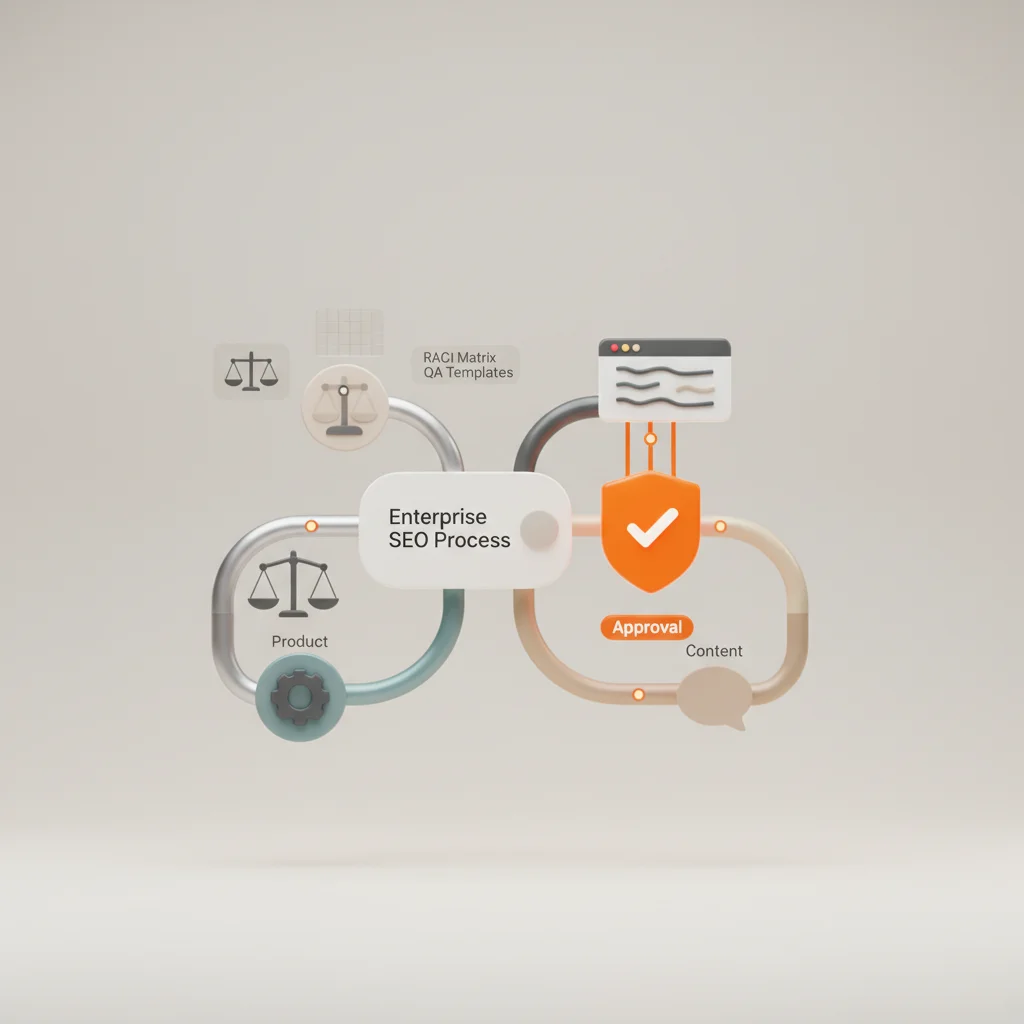
Speed up enterprise SEO approvals by establishing a RACI matrix, standardizing QA templates, and automating QA checks to align legal, product, and content stakeholders.
ON THIS PAGE
0% read
- The Enterprise Bottleneck: Why SEO Approvals Stall
- The Financial Impact: Quantifying the Cost of Delayed SEO Execution
- Step 1: Deploy an SEO RACI Matrix to Define Stakeholder Ownership
- Step 2: Standardize Pre-Approved SEO and Brand Guardrails
- Step 3: Automate QA Checks to Reduce Manual Review Cycles
- Step 4: Align Stakeholders Through Shared Incentives, KPIs, and Education
- Enterprise SEO Governance: Common Pitfalls and Risk Mitigation
Enterprise organic growth in complex organizations rarely fails due to poor keyword research or flawed technical strategy; it fails in the friction of organizational governance. Mastering how to speed up enterprise SEO approval processes requires transforming organic search from an external audit function into an integrated operational workflow. By establishing a clear RACI matrix, standardizing QA templates, pre-approving compliance guardrails, and automating CI/CD validation checks, enterprise organizations can eliminate departmental bottlenecks across legal, product, engineering, and brand teams. This guide provides a battle-tested framework for business owners, SEO directors, and digital leaders to shorten approval cycles from months to days while safeguarding brand compliance and maximizing organic revenue velocity.
The Enterprise Bottleneck: Why SEO Approvals Stall
Enterprise organizations operate with layers of governance designed to protect brand reputation, maintain regulatory compliance, and ensure technical stability. While these safeguards protect the enterprise from legal liabilities and platform downtime, they often create severe friction for organic search initiatives. An SEO recommendation—whether updating structured data, adjusting internal link architecture, or deploying programmatic landing pages—rarely exists in isolation. It touches the codebase governed by engineering, the user experience owned by product, the messaging scrutinized by brand marketing, and the claims monitored by legal and compliance departments.
When an SEO team delivers a batch of recommendations without a pre-negotiated governance structure, each department applies its own risk evaluation model. The engineering team prioritizes sprint velocity and architectural stability; the product team protects conversion funnels and user retention; the legal team minimizes regulatory exposure; and the brand team enforces editorial uniformity. Because SEO is often perceived as an external advisory channel rather than a core revenue driver, recommendations fall into organizational dead zones where no single stakeholder has the mandate or incentive to grant final sign-off.
The result is a compounding cycle of procedural inertia. A critical technical fix, such as resolving canonicalization conflicts across millions of parameterized URLs, sits in an engineering backlog across three quarterly planning cycles. Simultaneously, content optimizations stall within legal queues as counsel evaluates boilerplate terminology. To break this impasse, enterprise leaders must first diagnose the structural and cultural friction points unique to each stakeholder group before re-engineering the approval pipeline.
+-----------------------------------------------------------------------------------+
|                        ENTERPRISE SEO FRICTION ECOSYSTEM                          |
+-------------------+--------------------------------+------------------------------+
| Stakeholder Group | Primary Operational Objective  | Core SEO Friction Driver     |
+-------------------+--------------------------------+------------------------------+
| Legal & Compliance| Risk avoidance & regulation    | Unverified claims & liability|
| Engineering       | Architecture & sprint velocity | Scope creep & debt creation  |
| Product & UX      | Conversion rate & user journeys| Layout changes & page weight |
| Brand & Editorial | Voice consistency & authority  | Keyword insertion & phrasing |
+-------------------+--------------------------------+------------------------------+
The Legal and Compliance Barrier: Brand Protection vs. Search Performance
In regulated industries such as financial services (FinTech/Banking), healthcare (YMYL categories), telecommunications, and insurance, legal approval represents the most time-consuming phase of the content lifecycle. Legal counsels are trained to evaluate digital assets through the lens of liability mitigation, regulatory adherence (such as FTC guidelines, GDPR/CCPA privacy mandates, FDA compliance, or SEC disclosures), and trademark protection. Organic search optimizations, which frequently involve updating header hierarchies, adding semantic context, or refining meta descriptions, are often viewed by compliance officers as unvetted alterations that introduce risk.
The friction between legal and SEO teams stems from an asymmetry of communication. SEO practitioners communicate in terms of search volume, crawl budgets, and entity relevance, whereas compliance officers evaluate substantiate-ability of claims, mandatory disclaimers, and consumer protection risks. When SEO recommendations are submitted in raw spreadsheets or unstructured markup documents without clear compliance annotations, legal teams are forced to review every phrase from scratch. Lacking clarity on which elements are commercially sensitive versus which are standardized structural copy, legal reviews default to the lowest priority queue, taking anywhere from four to eight weeks per content batch.
Furthermore, legal teams often enforce rigid disclaimer mandates that can inadvertently conflict with mobile user experience and core Web Vitals. If the legal review process requires manual, individualized inspection of every single programmatically generated page, the scale that makes enterprise SEO profitable is neutralized. Resolving this tension requires codifying clear legal guardrails and establishing standardized, pre-approved modular templates that allow SEO teams to deploy content within legally safe parameters without triggering manual review loops for every iterative update.
The Product and Engineering Queue: Overcoming Development Backlog Friction
The engineering backlog is widely recognized as the primary bottleneck where technical SEO recommendations stall indefinitely. In enterprise environments, software engineering teams operate within structured Agile or Scrum frameworks driven by two-week sprint cycles, quarterly Objectives and Key Results (OKRs), and prioritized product roadmaps. A technical SEO ticket—such as implementing server-side rendering for JavaScript frameworks, optimizing hreflang tags, or correcting redirect chains—must compete directly with core product features, customer-facing bugs, and infrastructure security patches.
Engineering managers evaluate backlog items based on effort-versus-impact scoring models (such as RICE: Reach, Impact, Confidence, Effort). SEO tickets frequently fail to make sprint allocations because they are submitted as generalized technical audits rather than discrete, production-ready user stories. An audit stating "improve Core Web Vitals across category pages" does not provide developers with the specific root causes, acceptance criteria, or performance budgets necessary for sizing a sprint ticket. Consequently, engineering leads deprioritize SEO tasks in favor of product tickets with unambiguous specifications and direct commercial attribution.
+-------------------------------------------------------------------------------------+
|                         ENGINEERING TICKET SIZING COMPARISON                        |
+-----------------------+-----------------------------+-------------------------------+
| Attribute             | Poorly Structured SEO Ticket| Production-Ready User Story   |
+-----------------------+-----------------------------+-------------------------------+
| Specification Clarity | Vague ("Fix CLS issues")    | Precise element selectors     |
| Acceptance Criteria   | Missing or subjective       | Binary, testable thresholds   |
| Commercial Framing    | "Improves Google rankings"  | Quantified revenue impact     |
| QA Instructions       | "Verify in Search Console"  | Staging environment curl tests|
+-----------------------+-----------------------------+-------------------------------+
Moreover, modern enterprise architectures involve distributed microservices, complex content management systems (such as Adobe Experience Manager, Sitecore, or headless setups via Contentful), and multi-region continuous deployment pipelines. Making what seems like a simple template change to a footer link architecture can require updates across multiple code repositories, extensive regression testing, and sign-offs from multiple product managers. Without dedicated technical SEO sprint allocations and alignment with engineering KPIs, critical search infrastructure fixes remain permanently relegated to the bottom of the backlog.
The Brand Voice Dilemma: Balancing Editorial Standards with Search Intent
Brand marketing teams are the custodians of corporate identity, editorial voice, and market positioning. Friction between SEO strategists and brand editors typically arises when keyword optimization and search intent alignment are perceived as degrading the elegance, sophistication, or narrative tone of enterprise content. Editorial teams often resist recommendations that suggest specific heading formulations, natural language question variants, or structured taxonomy adjustments, viewing them as robotic or detrimental to brand perception.
This ideological divide is exacerbated when SEO teams deliver optimization briefs that focus solely on lexical frequency rather than topical completeness and semantic depth. When a copywriter or editorial director receives a brief demanding the exact insertion of secondary phrases into refined corporate copy, the natural response is pushback, triggering multiple rounds of editorial re-drafting and defensive review meetings. This back-and-forth can add weeks to the publication timeline of brand-critical campaigns.
To eliminate this friction, enterprise organizations must shift their content strategy from lexical keyword matching to entity-based search optimization. When brand editors understand that search engines prioritize topical authority, clear informational hierarchy, and direct user satisfaction over rigid phrase repetition, the editorial review process transforms from an adversarial negotiation into a collaborative refinement of content quality. Establishing a shared vocabulary and integrating SEO principles directly into the brand style guide bridges the gap between editorial integrity and organic discoverability.
The Financial Impact: Quantifying the Cost of Delayed SEO Execution
The most effective mechanism for gaining executive buy-in to overhaul approval workflows is translating operational latency into financial metrics. In enterprise organizations, delay is rarely treated as a direct financial loss; it is viewed merely as an extended timeline. However, organic search is a compound-growth channel governed by continuous algorithmic re-indexing and competitor evolution. Every month an SEO implementation is delayed represents a permanent, unrecoverable loss of organic traffic, customer acquisition value, and market share.
When digital leaders quantify the exact dollar value of approval lag, executive leadership quickly re-evaluates the cost of organizational bureaucracy. The financial impact of delayed SEO execution manifests across three distinct economic dimensions: direct opportunity cost, competitive algorithmic decay, and operational waste generated by constant context switching.
Calculating Lost Organic Revenue Opportunity (Opportunity Cost Modeling)
The opportunity cost of delayed SEO execution can be modeled mathematically to demonstrate the real cost of corporate hesitation. When an optimization initiative—such as re-architecting product categories or rolling out technical schema—is delayed by six months, the enterprise does not simply push the revenue curve forward by six months; it completely forfeits the compound traffic that would have accrued during that window.
The standard enterprise model for calculating the cost of delay (CoD) in organic search combines projected search volume capture, expected click-through rates (CTR) based on ranking improvements, conversion rates (CVR), and average order value (AOV) or customer lifetime value (LTV):
$$\text{Monthly Cost of Delay} = \sum \left( \Delta \text{Projected Organic Sessions} \times \text{Conversion Rate} \times \text{Average Order Value} \right)$$
Consider an enterprise e-commerce platform with an SEO initiative projected to capture 250,000 additional monthly organic visits across its core commercial categories. Assuming a conservative conversion rate of 2.2% and an average order value of $120, the projected incremental monthly revenue is:
$$\text{Incremental Monthly Revenue} = 250{,}000 \times 0.022 \times \$120 = \$660{,}000 / \text{month}$$
If this initiative sits in a cross-departmental approval loop involving product, legal, and engineering for five months, the cumulative direct revenue lost to the business is $3.3 million. Once that five-month window passes, that revenue is gone forever; it cannot be retroactively recovered by launching the project in month six.
Presenting these figures to the Chief Marketing Officer (CMO), Chief Technology Officer (CTO), and Chief Financial Officer (CFO) changes the strategic narrative. Approval delays cease to be an internal operational inconvenience and become recognized as a major drain on enterprise profitability.
Algorithmic Decay and Volatility During Prolonged Approval Lags
Beyond simple linear revenue modeling, prolonged approval cycles introduce severe algorithmic risks. Modern search engines evaluate websites dynamically, adjusting indexing frequency, quality scores, and entity associations based on continuous signals. When technical debt, broken page experiences, crawl inefficiencies, or outdated content sit unaddressed for extended periods, the domain suffers from algorithmic decay.
During an algorithmic core update, search engines recalibrate their evaluation of overall site quality, content helpfulness, and technical performance. If an enterprise site has identified critical issues—such as widespread duplicate content, poor Core Web Vitals scores, or incorrect canonical implementation—but cannot deploy the fixes due to a four-month governance cycle, the site enters the update window compromised. A site that loses 20% of its organic visibility during a major core update due to unaddressed technical deficiencies faces a recovery timeline that often spans 6 to 18 months, requiring subsequent core updates to regain historical ranking baselines.
Furthermore, while the enterprise is immobilized by review cycles, agile competitors deploy continuous iterations. In competitive SERPs, search visibility is a zero-sum environment: every day an enterprise delays claiming a topical entity or resolving a technical friction point is a day an agile competitor solidifies their authority and captures backlink equity, making them significantly more difficult to displace in future cycles.
Engineering and Operational Waste from Context Switching
The financial waste of sluggish approval processes also manifests internally within operational expenditure. When an SEO team, technical writer, or engineering squad builds a recommendation or develops a staging feature, that asset holds maximum context at the moment of completion. When that deliverable enters a weeks-long approval limbo, operational friction multiplies exponentially.
Developers and content creators must repeatedly revisit closed work to refresh context, resolve merge conflicts with subsequent code deployments, re-verify staging links, and re-run manual QA checks. A technical ticket that required 20 engineering hours to build initially can consume an additional 15 to 30 hours in maintenance, re-testing, and administrative status meetings as it moves in and out of dormant states across multiple sprint reviews. This context-switching tax inflates the true development cost of SEO initiatives, leading engineering leads to mistakenly conclude that organic search features carry an unsustainably high total cost of ownership (TCO).
Step 1: Deploy an SEO RACI Matrix to Define Stakeholder Ownership
The primary structural cause of approval paralysis is ambiguous ownership. In many enterprise environments, it is unclear who holds the authority to make a final decision on an SEO trade-off. When a product manager fears a title tag change might marginally alter conversion copy, or when a brand editor dislikes a schema markup breadcrumb, the lack of defined authority results in endless consensus-seeking meetings where every stakeholder holds a soft veto.
To eliminate this structural flaw, enterprise organizations must implement a formalized RACI Matrix (Responsible, Accountable, Consulted, Informed) specifically calibrated for organic search operations. A properly configured RACI framework establishes unambiguous role boundaries, ensuring that input is gathered efficiently while restricting decision-making authority to a single accountable owner per operational category.
Defining Roles: Who is Responsible, Accountable, Consulted, and Informed?
A functioning SEO RACI framework must clearly delineate the four core governance roles across all major SEO work streams (Technical SEO, Content Creation & Refresh, Information Architecture, and Metadata):
Responsible (R): The practitioner or team tasked with creating the deliverable, writing the code, drafting the copy, or executing the technical change. (e.g., SEO Specialist, Front-end Developer, Copywriter).
Accountable (A): The single individual who possesses the ultimate decision-making authority and veto power. Crucially, there can only be one Accountable person per work stream to prevent conflicting mandates. This person owns the business outcome.
Consulted (C): Subject matter experts whose input must be solicited before the work is completed or approved (e.g., Legal Counsel, Brand Director, UX Lead). Being "Consulted" is a two-way communication channel, but it does not grant veto power over the Accountable owner unless a hard compliance or system stability threshold is breached.
Informed (I): Stakeholders who must be notified of updates, deployments, and performance impacts after the decision is executed (e.g., Customer Support, Paid Media Teams, Regional Marketing Managers). Communication is one-way.
+-----------------------------------------------------------------------------------------------+
|                             ENTERPRISE SEO RACI GOVERNANCE MATRIX                             |
+------------------------------+------------+-------------+-------------+---------+-------------+
| SEO Work Stream              | SEO Team   | Engineering | Product/UX  | Legal   | Brand/Comms |
+------------------------------+------------+-------------+-------------+---------+-------------+
| Core Web Vitals & Perf.      | C          | A / R       | C           | I       | I           |
| Structured Data (Schema)     | A          | R           | I           | I       | I           |
| Meta Titles & Descriptions   | A / R      | I           | C           | I       | C           |
| Core Commercial Landing Pages| R          | I           | A           | C       | C           |
| Programmatic Page Taxonomy   | A          | R           | C           | C       | I           |
| Regulatory YMYL Content      | R          | I           | I           | A       | C           |
| Internal Linking Architecture| A / R      | R           | C           | I       | I           |
+------------------------------+------------+-------------+-------------+---------+-------------+
Assigning clear accountability resolves cross-departmental friction. For example, when updating standard meta descriptions and title tags for non-YMYL e-commerce product pages, the Head of SEO is designated as Accountable, while the Brand Team is Consulted. If the Brand team does not provide feedback within the agreed-upon SLA window, the Accountable owner retains the executive authority to push the update directly to production.
Establishing Clear SLAs (Service Level Agreements) for Turnaround Times
A RACI matrix without time-bound Service Level Agreements (SLAs) quickly degrades into theoretical governance. Enterprise teams must establish binding turnaround windows across every review node in the workflow. These SLAs must be formally integrated into Jira, Asana, Monday.com, or enterprise workflow management platforms to trigger automated escalations when a review deadline approaches.
Standardizing enterprise review SLAs requires tiered prioritization based on task risk and commercial impact:
Tier 1: Emergency & Algorithmic Blocker (SLA: 24-48 Hours)
Scope: Accidental sitewide noindex tags, robots.txt crawl blocks, critical canonical loops, major tracking failures, or critical security vulnerabilities.
Governance: Direct bypass to emergency deployment sprint; engineering and SEO leads hold immediate joint sign-off authority.
Tier 2: High-Priority Strategic Deployments (SLA: 3-5 Business Days)
Scope: Major product category launches, critical technical schema updates, site migration URL redirect mappings, and primary navigational architecture adjustments.
Governance: Legal, Product, and SEO stakeholders must complete reviews within 5 business days. Failure to provide explicit feedback constitutes implicit consent, allowing the Accountable owner to release the ticket.
Tier 3: Standard Editorial and Iterative Optimizations (SLA: 5-7 Business Days)
Scope: Routine blog publications, metadata updates, historical content refreshes, and internal link additions.
Governance: Handled through self-serve validation protocols and standardized templates with zero requirement for synchronous review meetings.
Creating an Escalation Path for High-Priority SEO Fixes
When cross-functional deadlocks inevitably occur—such as an engineering manager refusing to allocate resources for a critical hreflang overhaul or a compliance officer blocking an entire content hub due to a single contested sentence—the organization must have a predetermined escalation protocol.
The escalation framework should consist of a three-step path that prevents disputes from lingering unresolved in committee meetings:
Peer-to-Peer Resolution (Level 1 - 48-Hour Cap): The SEO Director and the corresponding Lead (Engineering Manager, Product Lead, or Legal Counsel) meet for a 15-minute structured sync. The SEO lead presents the quantified revenue risk and specific acceptance criteria; the counterpart presents the technical or legal constraint. If a compromise cannot be reached within 48 hours, the ticket automatically escalates.
VP-Level Operational Arbitrage (Level 2 - 72-Hour Cap): The dispute moves to the VP of Marketing/Organic Growth and the VP of Product or VP of Engineering. The evaluation at this stage is strictly commercial: does the projected organic revenue return outweigh the technical effort or alternative product opportunity cost?
Executive Committee Final Ruling (Level 3 - Final Arbiter): For multi-million-dollar initiatives or existential site architecture decisions (such as platform migrations), the decision rests with the Chief Digital Officer (CDO) or Chief Technology Officer (CTO). The ruling is final and documented as organizational precedent for future tickets.
Step 2: Standardize Pre-Approved SEO and Brand Guardrails
Manual reviews do not scale in enterprise environments. An enterprise managing hundreds of thousands or millions of URLs cannot subject every title tag modification, FAQ addition, or content expansion to an individualized manual review process involving legal and brand teams. The only viable path to rapid operational velocity is governance by design: creating standardized, pre-approved structural frameworks and compliance guardrails that allow teams to create, optimize, and deploy content autonomously within guaranteed safety boundaries.
By establishing pre-cleared content modules, dynamic taxonomy rules, and self-serve validation checklists, the enterprise shifts its quality assurance paradigm from reactive, synchronous inspection to proactive, asynchronous compliance.
Developing Legal-Approved Content Templates and Taxonomy Frameworks
The most effective method for accelerating legal compliance in SEO is the modularization of digital assets. Content should be deconstructed into discrete functional blocks: structural templates, dynamic entity fields, and pre-cleared legal boilerplates.
In collaboration with corporate compliance and legal teams, the SEO lead develops a comprehensive Content Taxonomy and Modular Language Framework. Under this model, legal counsel reviews and signs off on the underlying structure, variable logic, and standardized claims of a content format once, rather than inspecting each individual output page.
Modular Disclaimers & Dynamic Insertions: Standardized disclaimers (e.g., financial APR calculations, medical advisory notices, geographical licensing restrictions) are hard-coded into the CMS as programmatic modules linked to specific product categories or geographic user locations. When an SEO team deploys a new programmatic category page, the correct compliance disclaimer is dynamically appended automatically.
Pre-Cleared Claim Libraries: Legal teams pre-approve a centralized repository of competitive claims, feature descriptions, and performance statistics within the enterprise Digital Asset Management (DAM) or CMS. Copywriters and SEO content specialists are authorized to assemble content utilizing any combination of these approved statements without requiring secondary compliance sign-off.
Variable Token Logic for Programmatic Metadata: For programmatic SEO at scale (such as location pages or product filter combinations), the legal team inspects and signs off on the variable pattern rules:
$$\text{Meta Title Rule: } \{\text{Primary Keyword}\} \text{ in } \{\text{City}\} \mid \{\text{Brand Name}\} - \{\text{Pre-Approved Value Proposition}\}$$
Once the structural syntax is approved, the SEO and engineering teams can generate and deploy 50,000 unique localized landing pages without submitting a single ticket to the legal queue.
Implementing Self-Serve QA Checklists for Content and Product Teams
To prevent low-quality or non-compliant tickets from entering the engineering and editorial workflows, enterprise organizations must implement Self-Serve Quality Assurance (QA) Checklists . These checklists empower product managers, UX designers, and copywriters to audit their own deliverables against SEO and compliance baselines prior to submission. These checklists must be embedded directly into project templates within task management software (Jira issue templates, Confluence project pages, Google Docs publishing extensions). A task cannot be transitioned to the "Ready for Review" status until the author completes a mandatory digital sign-off confirming that all baseline criteria have been fulfilled. +------------------------------------------------------------------------------------+ | ENTERPRISE PRE-FLIGHT QA CHECKLIST | +-------------------+------------------------------------------+---------------------+ | Verification Area | Requirement Checkpoint | Mandatory / Optional| +-------------------+------------------------------------------+---------------------+ | Technical Syntax | Exactly one H1 tag containing target entity| Mandatory | | URL Structure | Lowercase, hyphen-separated, clean slug | Mandatory | | Legal Compliance | Standard YMYL dynamic disclaimer selected| Mandatory (If YMYL) | | Performance Budget| Images compressed to WebP/AVIF under 150KB| Mandatory | | Structured Data | Schema markup validated in schema.org | Mandatory | | Brand Tone | Readability score aligned with guidelines| Mandatory | +-------------------+------------------------------------------+---------------------+ Distributing QA responsibility to the originators of content reduces the volume of superficial errors that typically bog down central SEO and editorial teams, freeing subject matter experts to focus on high-impact strategic initiatives. Setting Up a Pre-Cleared "Green Channel" for Low-Risk SEO Updates Not all SEO modifications carry the same level of organizational risk. Modifying the primary checkout flow or altering sitewide privacy policies carries high risk; however, adjusting image alt attributes, updating internal link anchor text, correcting heading tag nesting, or refining meta descriptions on evergreen informational articles carries virtually zero operational or regulatory risk. Enterprise governance must institute a formalized "Green Channel" (Fast-Track Protocol) . The Green Channel is a fast-track approval workflow that automatically grants the SEO team direct publishing access or single-click approval status for pre-defined low-risk updates, completely bypassing multi-departmental review queues. To qualify for the Green Channel, modifications must meet strict objective criteria:
Zero Structural Layout Alteration
The change does not modify user interface elements, primary call-to-action (CTA) button positions, or core conversion funnels.
Pre-Approved Lexical Boundaries
Text updates do not contain pricing figures, legally sensitive guarantees, competitive superiority claims, or forward-looking statements.
Strict Performance Envelope
Technical changes do not introduce third-party JavaScript libraries or increase the page's cumulative bundle size.
Any ticket meeting these parameters bypasses the standard multi-week review lifecycle and moves directly from staging validation to production deployment within 24 to 48 hours.
Step 3: Automate QA Checks to Reduce Manual Review Cycles
The traditional enterprise review model relies on human inspection: an SEO specialist manually crawls a staging environment, manually verifies meta tags, manually runs lighthouse audits, and writes manual tickets when regressions are detected. This manual approach is inherently unscalable, prone to human error, and introduces massive delays into the software release cycle.
To achieve enterprise velocity, organizations must treat SEO as Code. By integrating automated technical SEO testing directly into the Continuous Integration / Continuous Deployment (CI/CD) pipeline and deploying Edge SEO solutions, technical search governance becomes an automated, continuous, and self-enforcing engineering safeguard.
Integrating Automated Technical SEO Audits into the CI/CD Pipeline
In high-velocity engineering environments where code is deployed to production daily or weekly, manual staging reviews represent an intolerable bottleneck for development leads. The modern solution is embedding automated SEO regression assertions into the CI/CD build process using tools such as Cypress, Playwright, Puppeteer, Lighthouse CI, and enterprise crawling APIs (such as Botify, DeepCrawl/Lumar, or custom headless browser test suites).
When an engineer opens a pull request (PR) in GitHub, GitLab, or Bitbucket, the CI pipeline automatically spins up an ephemeral staging preview and executes automated SEO unit and integration tests. If the code introduces a critical regression, the build fails automatically, preventing the faulty code from ever reaching the production environment.
+-----------------------------------------------------------------------------------+
|                        AUTOMATED CI/CD SEO TESTING PIPELINE                       |
+-----------------------------------------------------------------------------------+
| 1. Developer Pull Request (PR) Initiated                                          |
|    └─> Ephemeral staging environment built automatically                          |
+-----------------------------------------------------------------------------------+
| 2. Automated Headless Browser Assertions (Cypress / Playwright)                   |
|    ├─> Test: Verify exactly one <h1> tag is present in DOM                        |
|    ├─> Test: Assert <meta name="robots"> does NOT contain 'noindex'               |
|    ├─> Test: Verify canonical URL matches defined canonicalization logic         |
|    └─> Test: Validate Schema.org JSON-LD syntax against Schema validator          |
+-----------------------------------------------------------------------------------+
| 3. Performance & Core Web Vitals Gate (Lighthouse CI)                             |
|    ├─> Assert Largest Contentful Paint (LCP) <= 2.5s on mobile emulation          |
|    └─> Assert Cumulative Layout Shift (CLS) <= 0.1                                |
+-----------------------------------------------------------------------------------+
| 4. Pipeline Decision Gate                                                         |
|    ├─> PASSED: Automatic green light for code merge                               |
|    └─> FAILED: PR blocked; detailed error report automatically added to PR ticket |
+-----------------------------------------------------------------------------------+
By shifting SEO validation left into the development lifecycle, the SEO team eliminates the need to manually audit every minor release. Developers receive instant, actionable feedback in their native pull request interface, resolving issues before they impact the live site.
Continuous Content Regression Testing and Real-Time Page Integrity Monitoring
Technical regressions do not occur exclusively during software deployments; they also happen when non-technical content creators accidentally overwrite optimized copy, delete high-value internal links, unpublish parent category URLs, or break structured data markup within the CMS.
Enterprise organizations prevent these silent failures by deploying continuous monitoring platforms (such as ContentKing, Little Warden, or custom webhook monitors) that crawl production environments 24/7 in real time. These platforms detect unintended changes to canonical tags, robots meta directives, HTTP response codes, and content headers within minutes of occurrence.
When a regression is detected, the monitoring system immediately dispatches an automated alert via Slack or Microsoft Teams to the designated owner defined in the RACI matrix, complete with a diff comparison showing the exact code or content modification. This transforms the SEO team from reactive investigators into proactive quality controllers, reducing mean time to detection (MTTD) and mean time to resolution (MTTR) from months to hours.
Safe CDN Edge Deployments: Bypassing Core CMS Release Cycles with Edge SEO
One of the most transformative technical breakthroughs in enterprise organic search governance is Edge SEO. In many legacy enterprise architectures, updating the core CMS, modifying routing rules, or altering server headers requires extensive monolithic deployments that take months to navigate the engineering queue.
Edge SEO utilizes serverless edge compute workers running on the Content Delivery Network (CDN) layer—such as Cloudflare Workers, Fastly Compute@Edge, Akamai EdgeWorkers, or AWS CloudFront Functions—to execute SEO modifications on the request/response stream before it reaches the client browser, without modifying the underlying origin codebase.
+-----------------------------------------------------------------------------------+
|                             EDGE SEO EXECUTION MODEL                              |
+-----------------------------------------------------------------------------------+
| User / Googlebot Request                                                          |
|       │                                                                           |
|       ▼                                                                           |
| ┌───────────────────────────────────────────────────────────────────────────────┐ |
| │ CDN Edge Layer (Cloudflare Workers / Fastly VCL / Akamai EdgeWorkers)         │ |
| │  ├─ 1. Instant 301 Redirect Rules Execution (Bypasses origin server)          │ |
| │  ├─ 2. Dynamic Hreflang Injection based on request headers                     │ |
| │  ├─ 3. Automated JSON-LD Schema Injection                                     │ |
| │  └─ 4. Response Header Optimization (X-Robots-Tag, Cache-Control)             │ |
| └───────────────────────────────────────────────────────────────────────────────┘ |
|       │                                                                           |
|       ▼                                                                           |
| Origin Server / Legacy Monolithic CMS (Unchanged, Unburdened)                     |
+-----------------------------------------------------------------------------------+
Deploying low-risk optimizations at the edge—such as executing large-scale URL redirect maps during a re-platforming project, injecting structured data, or serving pre-rendered HTML to search engine bots—allows the SEO team to operate with agility while completely eliminating resource demands on the core engineering backlog. Because edge workers can be tested in isolated staging environments and rolled back instantly via automated version control, they represent a low-risk, high-velocity implementation pathway for enterprise organizations.
Follow these sequential stages to integrate automated search engine optimization assertions into your enterprise release lifecycle. Draft deterministic, binary rules for critical technical elements including canonical tags, robots directives, schema validity, and Core Web Vitals thresholds. Translate assertions into executable end-to-end test scripts using modern frameworks like Playwright, Cypress, or Lighthouse CI. Configure repository webhooks to automatically trigger test execution upon the creation of any new staging branch or pull request. Set hard blocking rules that automatically prevent code merging and notify developers if any core technical SEO regression is detected.CI/CD Automated SEO Deployment Pipeline
Define Testable SEO Acceptance Assertions
Script Automated Headless Browser Tests
Embed Test Suites into the CI Build Configuration
Establish Automatic Build Failure Gates
Step 4: Align Stakeholders Through Shared Incentives, KPIs, and Education
Process frameworks, RACI matrices, and automation tools provide the structural mechanics for rapid execution, but long-term organizational velocity depends on cultural alignment. Cross-departmental friction persists when stakeholders view SEO as an external mandate that creates work for them without advancing their individual departmental goals.
To build an agile enterprise SEO culture, leadership must align organizational incentives. SEO initiatives must be framed not as isolated marketing tasks, but as direct contributors to the KPIs and OKRs that engineering leads, product managers, brand directors, and corporate executives are already measured against.
Translating SEO Metrics into Engineering, Product, and Commercial KPIs
SEO practitioners frequently make the mistake of communicating with cross-functional stakeholders using organic-search-specific jargon: domain authority, crawl budget, keyword search volume, and SERP feature penetration. These metrics mean very little to an engineering director focused on site reliability, or a product manager evaluated on user retention and conversion velocity.
To accelerate approvals, SEO leaders must systematically translate organic search requirements into the native metric languages of their internal partners:
+------------------------------------------------------------------------------------+
|                         CROSS-DEPARTMENTAL METRIC TRANSLATION                      |
+---------------------+-------------------------------+------------------------------+
| Stakeholder Group   | Traditional SEO Pitch (Ignored)| Translated Alignment Pitch   |
+---------------------+-------------------------------+------------------------------+
| Engineering / DevOps| "We need to fix Core Web      | "Resolving these assets      |
|                     | Vitals for Google rankings."  | reduces server compute costs |
|                     |                               | by 18% and lowers TTFB."     |
+---------------------+-------------------------------+------------------------------+
| Product Managers    | "We must add 500 words of     | "This structured modular copy|
|                     | copy to the category page."   | reduces user bounce rates and|
|                     |                               | increases add-to-cart by 4%."|
+---------------------+-------------------------------+------------------------------+
| Legal & Compliance  | "We need fast approval on our | "These pre-cleared templates |
|                     | new comparison content hub."  | eliminate 85% of ad-hoc      |
|                     |                               | manual review submissions."  |
+---------------------+-------------------------------+------------------------------+
| Executive Suite     | "We increased impressions by  | "Organic search generated    |
| (CFO / CMO)         | 34% across non-brand terms."  | $4.2M in pipeline, lowering  |
|                     |                               | customer acquisition cost."  |
+---------------------+-------------------------------+------------------------------+
When an engineering manager realizes that implementing server-side caching and optimizing images improves overall site performance and infrastructure efficiency, the SEO ticket is no longer viewed as an external chore; it is embraced as an engineering achievement that fulfills their own technical OKRs.
Executive Dashboards: Connecting Search Visibility Directly to Pipeline and Revenue
Enterprise decision-makers do not have the time to parse 40-page crawl reports or complex keyword ranking spreadsheets. When reporting to the C-suite, SEO performance must be consolidated into clean, executive-level business intelligence dashboards (utilizing platforms such as Looker, Power BI, or Tableau) that directly link search visibility to pipeline velocity, customer acquisition cost (CAC) reduction, and net revenue.
An executive-level SEO reporting architecture should focus on four primary macro-metrics:
Organic Share of Voice (SoV) vs. Market Competitors: Measuring the enterprise's visibility across core commercial entity clusters against primary competitors, showing market share expansion or contraction.
Blended Customer Acquisition Cost (CAC) Optimization: Demonstrating how growth in organic traffic volume lowers the organization's reliance on escalating paid search (PPC) and performance marketing expenditure.
Net Organic Revenue & Pipeline Contribution: Direct multi-touch and first-touch attribution modeling tying organic search interactions to closed-won revenue, average deal size, and customer lifetime value.
Operational Velocity Metrics: Tracking internal approval turnaround times, engineering ticket implementation rates, and green-channel deployment volumes to maintain accountability across departments.
When the executive leadership team clearly sees the correlation between rapid SEO execution and commercial outperformance, they naturally mandate cross-departmental cooperation, dismantling bureaucratic barriers across the entire enterprise.
Continuous Governance Feedback Loops and Cross-Departmental SEO Enablement
Organizational alignment is not a one-time initiative; it requires continuous reinforcement and education. Leading enterprise organizations institute continuous enablement programs that build organic search literacy across product, engineering, and editorial teams.
Quarterly Lunch-and-Learns & Technical Demos: Hosting brief, high-value knowledge-sharing sessions with engineering squads to review the latest web platform standards, headless rendering best practices, or Core Web Vitals optimizations.
The "SEO Office Hours" Model: Establishing dedicated, weekly open-door virtual consulting hours where copywriters, product managers, and legal reviewers can bring early-stage concepts for quick, informal feedback before drafting formal tickets.
Celebrating Cross-Functional Wins: When an organic search initiative drives a significant commercial result, the SEO team must publicly celebrate and attribute that success to the engineers who wrote the code, the product managers who allocated sprint capacity, and the legal counsels who cleared the templates. Shared recognition builds long-term goodwill and accelerates future approval cycles.
Compare the operational characteristics of legacy bureaucratic workflows against an optimized, agile enterprise framework. Avantaj Single Accountable owner per work stream backed by a strict RACI matrix and clear SLAs. Dezavantaj Distributed, consensus-seeking committee reviews where multiple departments hold undefined veto power. Avantaj Automated CI/CD build assertions, real-time regression monitoring, and pre-cleared modular templates. Dezavantaj Manual, spreadsheet-based human inspections across staging environments causing multi-week release delays. Avantaj SEO requirements translated into native engineering, product, and commercial revenue KPIs. Dezavantaj SEO presented in search-specific jargon, perceived as an unallocated tax on engineering and editorial bandwidth.Traditional Siloed SEO vs. Modern Agile SEO Governance
Decision-Making Authority
Review & QA Execution
Cross-Departmental Incentives
Enterprise SEO Governance: Common Pitfalls and Risk Mitigation
Accelerating enterprise SEO approvals is not about cutting corners or bypassing institutional safeguards; doing so introduces severe legal liabilities, brand degradation, and technical instability. Rather, the goal is optimizing operational efficiency while maintaining the integrity of enterprise governance. When organizations attempt to speed up workflows without proper structural design, they frequently encounter common pitfalls that can derail the entire optimization program.
Over-Engineering the RACI Matrix into Bureaucratic Paralysis
A frequent mistake in enterprise governance is designing a RACI matrix that is excessively granular and complex. When every minor operational task requires consulting ten different individuals across six departments, the governance tool itself becomes a new source of bureaucracy.
To avoid this trap, keep the RACI matrix lean. Ensure that no work stream has more than one Accountable individual, and strictly limit the number of Consulted stakeholders to those whose specialized expertise is genuinely required for regulatory compliance or system stability. All other secondary stakeholders should be categorized as Informed, receiving automated notifications post-deployment without the ability to halt the operational pipeline.
Compromising Brand Safety and Compliance to Accelerate Velocity
In an aggressive push to increase publication velocity, SEO teams sometimes attempt to bypass legal reviews entirely by publishing unvetted content or utilizing automated generative AI workflows without adequate human oversight. In regulated sectors (such as healthcare, banking, and legal services), this can result in catastrophic regulatory fines, severe brand reputational damage, or legal action from consumer protection bodies.
Speed should never come at the expense of regulatory integrity. The solution is not to bypass legal compliance, but to empower it through the pre-approved modular frameworks detailed in Step 2. When legal counsel helps construct the guardrails upfront, the enterprise achieves rapid operational velocity with complete institutional safety.
Failure to Track Post-Implementation SEO Impact and Feedback Metrics
The final failure mode is treating the deployment of an SEO ticket as the end of the governance process. If an enterprise establishes rapid approval channels but fails to measure the subsequent business performance of deployed tickets, cross-functional partners will lose faith in the program.
Engineering and product leaders who allocate sprint capacity want to see the empirical results of their investments. If a technical SEO feature is deployed via an expedited green channel, the SEO team must close the feedback loop by providing a 30-, 60-, and 90-day performance report detailing indexing rates, traffic improvements, and revenue generation. Demonstrating consistent, verifiable return on investment (ROI) reinforces the credibility of the SEO program, ensuring continued cross-departmental prioritization for future initiatives.
Frequently Asked Questions
How do you handle pushback from development teams regarding SEO tickets?
Development pushback is best resolved by translating SEO tickets into production-ready user stories complete with specific technical specifications, testable acceptance criteria, and quantified commercial revenue impact. Aligning SEO requirements with existing engineering priorities—such as site speed, infrastructure efficiency, and Core Web Vitals—transforms organic search recommendations from an unwelcome burden into shared technical achievements.
What is the fastest method to secure legal clearance for metadata and content updates?
The fastest approach is establishing pre-approved modular templates and dynamic variable syntax in collaboration with compliance counsel rather than submitting individual pages for manual review. By pre-clearing structural formats, standardized disclaimer logic, and claim libraries upfront, SEO teams can generate and publish thousands of optimized pages autonomously within agreed-upon regulatory boundaries.
Can automated QA testing tools completely replace manual SEO reviews?
Automated QA tools can successfully replace 80% to 90% of routine technical and structural verification by running automated unit tests, schema validations, and regression checks within CI/CD pipelines. However, manual reviews remain essential for high-impact strategic initiatives, complex site migrations, and nuanced brand-alignment evaluations on core commercial landing pages.
What is an acceptable SLA for enterprise SEO approval workflows?
High-performing enterprise organizations operate with tiered SLAs: 24 to 48 hours for critical technical emergencies and crawlability blockers, 3 to 5 business days for high-priority commercial deployments, and 5 to 7 business days for routine editorial updates. Establishing automatic consent clauses—where lack of response within the SLA window defaults to approval—prevents tickets from languishing indefinitely.
How does Edge SEO help circumvent traditional enterprise engineering backlogs?
Edge SEO uses serverless compute workers running at the CDN layer (such as Cloudflare Workers or Fastly Compute@Edge) to execute optimizations on server response streams before delivery to browsers. This allows SEO teams to deploy redirects, modify robots headers, and inject structured data safely without modifying the origin CMS codebase or consuming core development sprint capacity.
Who should be designated as the Accountable owner in an SEO RACI matrix?
Accountability must reside with a single individual who directly owns the business outcome of that specific work stream. For technical schema, programmatic taxonomy, and metadata architecture, the Head of SEO should be Accountable; for core commercial conversion pages, the Product Lead is typically Accountable, with the SEO lead serving as a mandatory Consulted partner.
How should enterprise SEO teams quantify the financial cost of approval delays?
Cost of delay is calculated by multiplying the projected incremental monthly organic sessions by the site's average conversion rate and average order value (or lead value), multiplied by the number of months the ticket is delayed. Demonstrating the cumulative, unrecoverable revenue forfeited during review cycles provides executive leadership with a clear business case to streamline governance.
How can an organization prevent brand voice degradation while optimizing for search intent?
Organizations should replace rigid keyword-stuffing directives with entity-based semantic optimization guidelines integrated directly into the corporate brand style guide. Educating editorial teams on topical completeness and structured information architecture allows writers to craft natural, high-authority copy that satisfies both search engine algorithms and brand standards.