
In-House SEO vs Agency vs Freelancer: Choosing the Right Model
Compare in-house teams, agencies, and freelancers to determine the optimal SEO operational model based on budget, resource scalability, and technical expertise.
ON THIS PAGE
0% read
- Introduction: The Dilemma of SEO Resource Allocation
- Understanding the Three SEO Models: In-House, Agency, and Freelancer
- Direct Comparison: Budget, Scalability, and Expertise
- Comprehensive Pros and Cons Breakdown Across Operating Models
- The Hybrid SEO Model: Maximizing Synergies Across Channels
- Decision Matrix: Aligning Your Organizational Profile with the Right Model
- Operational Execution: Onboarding, Tooling, and Governance
Selecting an operational model for organic search—whether deploying a dedicated in-house team, partnering with a full-service agency, or hiring specialized freelance consultants—dictates capital efficiency, execution velocity, and long-term brand equity. When deciding between In-House SEO vs Agency vs Freelancer: Choosing the Right Model requires evaluating structural cost, operational control, technical breadth, and organizational agility. This comprehensive strategic guide examines total cost of ownership (including tooling and overhead), resource elasticity, cross-functional communication, governance, and return on investment (ROI) across every model. It equips business owners, marketing directors, and growth executives with the analytical framework necessary to align organizational capabilities with organic market capture.
Introduction: The Dilemma of SEO Resource Allocation
Organic search performance has shifted from isolated keyword targeting to an enterprise-wide discipline intersecting software architecture, brand positioning, UX design, product marketing, data engineering, and generative engine optimization (GEO). For modern enterprises and scaling businesses, allocating budget and human capital to SEO is no longer a peripheral marketing decision. It is a core infrastructure investment that directly influences customer acquisition cost (CAC), customer lifetime value (LTV), and market defensibility.
Organizations frequently find themselves paralyzed at the intersection of three distinct execution paths. Building an internal team provides undivided focus and cultural alignment, yet introduces substantial fixed payroll liabilities, recruitment lead times, and potential skill-set stagnation. Retaining a specialized agency grants instant access to multidisciplinary technical talent, enterprise tooling infrastructure, and high-volume link or content pipelines, but can introduce retainer friction, divided account attention, and slower operational turnaround times. Engaging freelance consultants unlocks targeted expertise and agile turnaround for discrete challenges, yet requires substantial internal project management and lacks the execution throughput necessary for enterprise-scale organic growth.
The decision between building internally and outsourcing SEO is rarely binary. Misaligned resource strategies lead directly to catastrophic execution debt: technical tickets languishing in engineering backlogs, expensive software licenses left underutilized, shallow content production that fails algorithmic and generative search quality benchmarks, and unquantifiable agency retainers that obscure organic revenue attribution. Evaluating these pathways requires looking beyond headline pricing and conducting an audit of total operational drag, cross-functional dependencies, and leading versus lagging organic indicators.
Understanding the Three SEO Models: In-House, Agency, and Freelancer
To determine which operational structure aligns with a company's commercial trajectory, one must first deconstruct how each model functions within a digital marketing team structure. SEO is not a singular skill; it is an umbrella encompassing log analysis, Core Web Vitals optimization, rendering architecture (SSR vs. CSR), semantic ontology mapping, informational and commercial content architecture, digital PR, entity building, and conversion rate optimization (CRO). Each model mobilizes these functions differently.
What is In-House SEO? (Deep Focus & Direct Control)
An in-house SEO team consists of dedicated full-time employees (FTEs) embedded directly within an organization’s operational hierarchy. Depending on organizational maturity, an in-house setup may range from a single generalist SEO manager reporting to a Head of Growth, to a fully matrixed department comprising dedicated Technical SEO Architects, Content Strategists, SEO Copywriters, Data Analysts, and Outreach Specialists embedded within product and engineering squads.
The defining characteristic of in-house SEO is structural focus. An internal SEO specialist works on one domain, one product ecosystem, and one set of corporate objectives. They participate in daily standups, integrate into Jira/Linear sprint planning, interface directly with engineering and product leads, and navigate internal stakeholder dynamics to secure technical implementation resources. This operational proximity enables a granular understanding of brand voice, customer journeys, proprietary tech stacks, and unit economics.
However, in-house focus carries operational overhead. Internal practitioners operate within an echo chamber, isolated from broad cross-industry algorithmic shifts and multi-domain testing environments. If an internal SEO specialist encounters an esoteric edge case—such as an automated rendering failure on a custom headless Shopify build or complex canonicalization loops during an international ccTLD restructuring—they must resolve it without the institutional peer knowledge base that external service providers naturally possess.
What is an SEO Agency? (Diverse Expertise & Scale)
An SEO agency operates as an external, multi-disciplinary partner delivering managed services under a monthly retainer, project milestone, or performance-based agreement. Agencies assemble centralized teams consisting of technical directors, content managers, link building specialists, digital PR strategists, data scientists, and account directors who service a diverse portfolio of concurrent clients across B2B, B2C, e-commerce, and enterprise verticals.
The primary advantage of hiring an SEO agency is operational scalability and the democratization of diverse expertise. When an enterprise engages an established agency, they are not simply leasing human hours; they are purchasing access to proprietary workflows, extensive publisher networks for off-page authority development, established tool infrastructures, and macro-level algorithmic intelligence. Because agencies monitor performance shifts across hundreds of domains simultaneously, they can detect core algorithm update impacts, SERP volatility patterns, and Generative Engine changes weeks before an isolated in-house team recognizes a macro pattern.
The friction points of the agency model stem from capacity allocation and communication fragmentation. Account executives and strategists divide their cognitive load across multiple client accounts. A mid-tier client at a major agency may receive 15–25 actual operational hours per month from senior talent, with repetitive execution delegated to junior associates. Furthermore, agencies lack direct operational authority over a client’s codebase, meaning that agency deliverables—frequently delivered as extensive static PDF or Google Sheets audits—frequently stall if the client lacks internal engineering resources to execute recommendations.
What is an SEO Freelancer? (Agility & Specialized Skills)
An SEO freelancer is an independent contractor who provides specialized, hands-on consulting and execution on an hourly, daily, or project-based fee structure. High-caliber freelancers are often former agency directors, ex-in-house enterprise leads, or niche technical practitioners who have opted for operational autonomy. They generally specialize in discrete operational areas: technical architecture audits, complex site migrations, programmatic SEO system design, local SEO infrastructure, or specialized link acquisition.
Working with an SEO freelancer provides unmatched agility and direct communication efficiency. Decision-makers communicate directly with the strategist doing the actual work, entirely bypassing the account management and bureaucratic layers typical of traditional agencies. Freelancers can be onboarded rapidly—often within 48 to 72 hours—making them exceptionally valuable for time-sensitive triage, such as diagnosing sudden algorithmic traffic drops, supporting an impending domain migration, or filling a temporary parental leave gap in an in-house marketing department.
The primary limitation of the freelance model is systemic capacity. A single practitioner possesses finite working hours and cannot simultaneously manage enterprise-scale content production pipelines, high-volume digital PR campaigns, technical log file monitoring, and cross-functional stakeholder reporting. When a project demands substantial execution volume across multiple distinct domains, engaging an individual freelancer introduces resource bottlenecks and operational continuity risks.
Direct Comparison: Budget, Scalability, and Expertise
Selecting the correct operational model requires an objective assessment of organizational constraints. Evaluating models solely by initial price quotes obscures the total cost of ownership (TCO) and fails to account for implementation bottlenecks that directly suppress organic performance.
1. Budget Allocation and Hidden Operational Costs
When assessing SEO budget allocation, comparing a freelancer’s hourly rate directly to an agency’s monthly retainer or an in-house employee’s base salary is fundamentally flawed. A complete financial analysis must include recruitment costs, employment taxes, employee benefits, workspace/equipment overhead, software licensing, training, and operational friction.
Building an in-house team involves substantial fixed overhead. In tier-one commercial markets (such as the US, UK, and Western Europe), a mid-to-senior Technical SEO Strategist commands a base salary between $90,000 and $150,000 annually. When factoring in payroll taxes, healthcare, equity, operational bonuses, and equipment, the true employer burden increases by 25% to 35%, elevating total annual payroll liability to $120,000–$200,000 per specialist. Crucially, this practitioner cannot function effectively without enterprise software.
A standard in-house enterprise SEO tool stack—encompassing subscriptions to platforms such as Ahrefs ($999/mo for enterprise tiers), Semrush ($499/mo), Screaming Frog / Sitebulb ($250–$500/year), Botify or OnCrawl for enterprise log/rendering analysis ($1,500–$4,000+/mo), AccuRanker or Enterprise Rank Tracking ($500+/mo), and content optimization platforms like Clearscope or Surfer ($200–$500/mo)—adds an additional $15,000 to $50,000+ in annual software licensing expenses.
Total In-House Cost = (Base Salary × 1.30 Benefits/Tax Multiplier) + Recruitment Fees (15-25%) + Enterprise Software Stack ($15k-$50k) + Management DragBy contrast, an SEO agency consolidates these operational costs into a predictable monthly retainer ranging from $3,000 to $15,000+ per month for mid-market businesses, and $20,000 to $75,000+ per month for enterprise e-commerce or multinational corporations. The agency absorbs all tool licensing costs, internal training investments, hardware overhead, and employment liabilities. The hidden financial risk of an agency lies in scope creep, change-order fees for out-of-scope technical work, and long-term retainer lock-ins (typically 6- to 12-month master services agreements) that must be serviced regardless of business performance.
Freelancers represent an entirely variable cost model. With hourly rates ranging from $75 to $300+ per hour, or monthly advisory retainers between $1,500 and $6,000, freelancers present virtually zero fixed financial drag. There are no payroll taxes, benefits, or long-term contractual liabilities. However, hidden costs surface in the internal management bandwidth required to direct their output, synthesize their findings for executive stakeholders, and purchase separate third-party content creation or outreach services that the freelancer may not deliver in-house.
2. Resource Scalability, Workload Elasticity, and Ramp-Up Speed
Scalability represents the operational ease with which an organization can expand or contract its organic search execution capacity in response to market opportunities, seasonal shifts, or corporate capital constraints.
In-house teams exhibit poor resource scalability and low workload elasticity. If an enterprise suddenly decides to migrate 50,000 product URLs, restructure its international subfolders, or launch a 500-article programmatic content initiative, an internal team of one or two SEO specialists becomes an immediate operational bottleneck. Scaling internal capacity requires drafting job requisitions, screening candidates, conducting technical interviews, negotiating compensation, and navigating multi-month notice periods. If the company faces a macroeconomic downturn, downsizing an internal team incurs severe organizational friction, severance expenses, and loss of institutional momentum.
Agencies are built for resource elasticity. If a client secures additional marketing capital to capture a new product vertical, an agency can instantly scale operational output by assigning additional content strategists, digital PR outreach squads, and technical consultants from their centralized talent pool within days. Conversely, if economic conditions dictate a reduction in scope, retainer tiers can be renegotiated upon contract renewal without the legal and moral ramifications of staff terminations.
Freelancers provide hyper-elasticity for targeted workloads, but hard ceilings on total capacity. An organization can hire three specialized technical freelancers to execute an exhaustive log-file and rendering audit for a new platform launch over a four-week sprint, and terminate the engagements the moment the audit is complete. However, if that same organization needs 60 technical articles written, optimized, and interlinked per month alongside proactive digital PR outreach to top-tier media publications, an individual freelancer cannot scale to satisfy that operational volume without assembling and managing their own decentralized subcontractor network.
3. Breadth vs. Depth of Technical and Creative Expertise
The technical landscape of modern search demands deep specialization across fundamentally disparate disciplines. Evaluating operational models requires analyzing whether an organization requires broad, horizontal market capability or deep, vertical domain immersion.
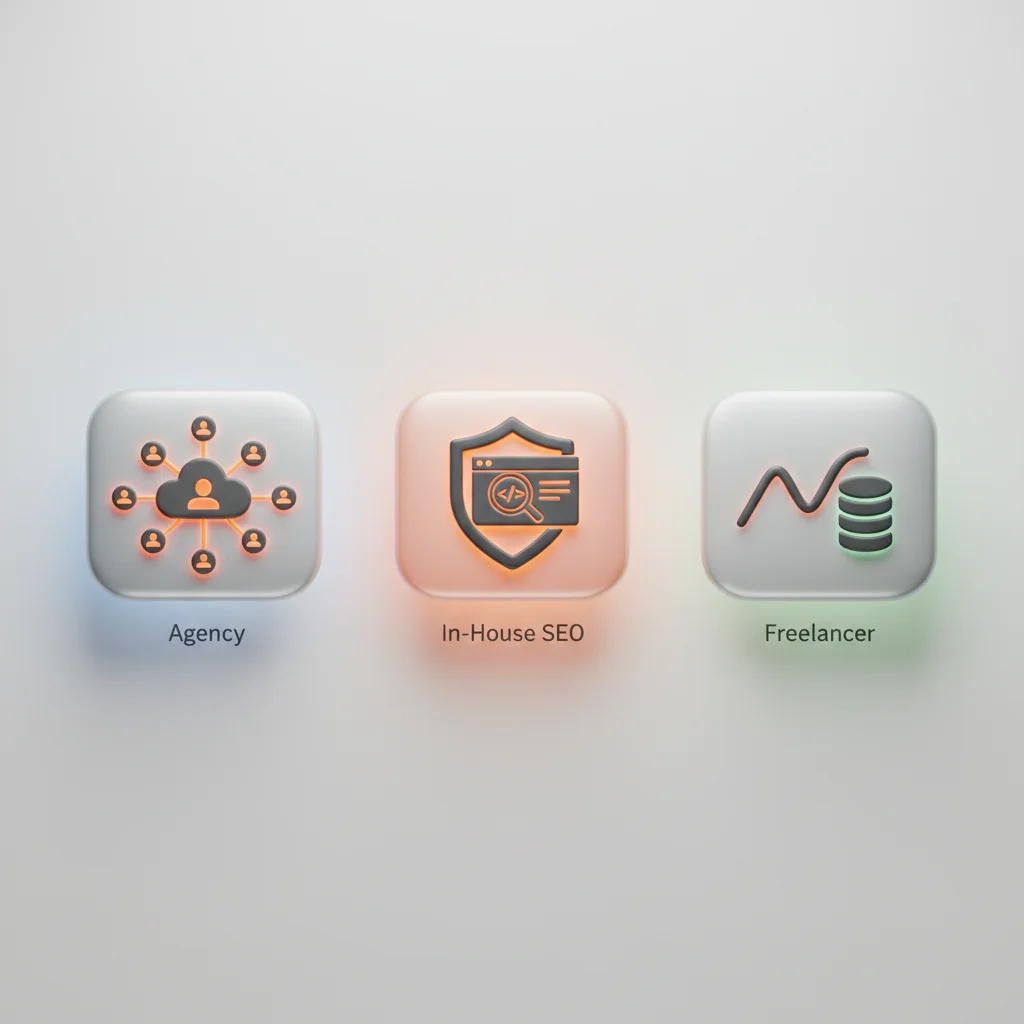
Agency Model: Wide Horizontal Breadth (Edge Case Exposure, Multi-Industry Intelligence, GEO Research)
In-House Model: Deep Vertical Immersion (CMS Architecture, Sprint Mechanics, Cultural Alignment, Unit Economics)
Freelance Model: Precision Niche Execution (Migrations, Core Web Vitals, Programmatic Frameworks)
In-house SEO professionals develop unmatched depth of contextual domain expertise. They understand the nuances of the company’s content management system, legacy code constraints, legal/compliance approval workflows, brand safety parameters, and the exact margins on every product line. They can identify which internal team members control the DNS settings, who can approve a redirect map in Cloudflare workers, and how to frame an SEO initiative to win approval from the Chief Product Officer. However, their technical breadth is constrained by their historical career exposure. If they have never executed a complex multi-language hreflang migration on a headless Next.js architecture, they must learn on company time through trial and error.
Agencies offer unmatched horizontal technical breadth. A premier agency employs specialists who focus exclusively on narrow vectors: one technical director might specialize solely in JavaScript hydration and server-side rendering, a PR director focuses exclusively on tier-one newsroom relationships for authoritative link building, and a data analyst builds automated Python scripts to detect cannibalization across millions of indexable pages. The agency brings institutional pattern recognition: having solved complex faceted navigation indexing issues for twelve other enterprise retailers, they can resolve the same problem for a new client in hours rather than weeks. The trade-off is shallow domain immersion; agency teams rarely understand the client’s internal operational bottlenecks as intimately as an internal employee.
Freelancers offer targeted, high-caliber vertical depth within their chosen specialty. Engaging an industry-recognized technical SEO freelancer to oversee a high-stakes enterprise domain consolidation provides access to elite, surgical expertise without paying for an entire agency account apparatus. The risk is that the freelancer’s skills may be highly asymmetric—possessing world-class knowledge in crawling dynamics and schema architecture, but limited capability in creative content strategy or executive-level corporate communication.
4. Communication Bandwidth, Governance, and Accountability
The operational efficacy of any SEO model is ultimately governed by implementation velocity. Recommendations that are not deployed to production generate zero organic revenue. Communication bandwidth and organizational governance dictate whether an SEO strategy translates into deployed code.
In-house SEO operates natively within internal communication ecosystems (Slack, Microsoft Teams, Jira, Asana). An internal SEO specialist can sit side-by-side with frontend engineers, join product sprint reviews, and informally pitch features to product managers over lunch. They can catch organic-damaging pull requests (such as accidental noindex injections or rogue canonical alterations) during standard staging environment QA reviews before code reaches production. The primary governance risk for in-house SEO is internal drift: without clear performance-based executive oversight, internal teams can easily become distracted by low-impact administrative tasks, internal committee meetings, and non-SEO marketing initiatives.
Agencies face structural communication barriers. Client-agency interactions are typically filtered through an Account Manager or Client Success Lead, creating an operational layer that can distort technical specifications. Direct communication between the client's lead software engineers and the agency’s technical strategists is often limited to formal bi-weekly or monthly calls. When an agency delivers a 100-page PDF audit containing hundreds of technical recommendations, the client’s internal engineering team often rejects it due to lack of context, unrealistic resource demands, or incompatibility with the existing development roadmap. Accountability in the agency model often degrades into a debate over inputs (hours delivered, reports generated) versus outputs (technical tickets deployed, organic revenue captured).
Freelancers offer direct, unmediated communication channels. There are no account managers; the client speaks directly with the engineer or strategist executing the analysis. This unmediated dynamic accelerates feedback loops and eliminates the bureaucratic misunderstandings common in agency engagements. However, accountability in freelance relationships is highly vulnerable to bandwidth fluctuations. Because freelancers lack organizational redundancy, an unexpected illness, personal emergency, or sudden influx of higher-paying client work can lead to missed deadlines and stalled implementation workflows.
Comparative assessment across operational vectors, cost structures, and governance dynamics. Avantaj Freelancers and Agencies absorb or eliminate dedicated tool and recruitment costs. Dezavantaj In-house teams require heavy fixed capital for salary, benefits, and tool licensing ($15k–$50k/yr). Avantaj In-house specialists participate in native sprint planning and pull-request QA cycles. Dezavantaj Agencies and freelancers face external communication friction and cannot force engineering deployment. Avantaj Agencies leverage aggregated data across hundreds of domains to decode algorithm updates rapidly. Dezavantaj In-house teams operate in a single-domain silo with limited exposure to broader market shifts. Avantaj Freelancers can be engaged or paused on 30-day terms with zero operational drag. Dezavantaj In-house personnel adjustments incur high legal, severance, and cultural costs.In-House vs Agency vs Freelancer Decision Matrix
Capital Overhead & Tooling TCO
Cross-Functional Deployment Speed
Technical Edge-Case Intelligence
Contractual & Operational Elasticity
Comprehensive Pros and Cons Breakdown Across Operating Models
Every operational structure possesses structural advantages and inherent vulnerabilities. Understanding these trade-offs allows leadership to proactively design counter-measures—such as pairing an internal hire with external specialists or embedding governance requirements into agency MSAs.
The Pros and Cons of In-House SEO Teams
An internal SEO department provides unmatched organizational alignment, but exposes the business to talent retention risks and significant fixed overhead.
Deep Cultural and Product Immersion: The internal practitioner lives and breathes the company’s value proposition, brand guidelines, customer friction points, and long-term strategic vision.
Direct Access to Engineering and CMS Infrastructure: Being part of the internal organization allows the SEO to build direct relationships with developers, participate in daily standups, and monitor staging environments for indexing regressions.
100% Dedicated Resource Focus: All working hours are focused on a single domain portfolio, eliminating the divided attention and competing priorities inherent to client service models.
Commercial Confidentiality and Intellectual Property Security: Proprietary algorithms, customer data, and high-stakes product roadmaps remain strictly internal without third-party exposure.
High Fixed Payroll and Software Cost: Full salary, benefits, recruiting fees, hardware, and an enterprise tool stack create a substantial permanent cost center that cannot be quickly adjusted during downturns.
Single Point of Failure and Attrition Risk: If a solo in-house SEO leaves the organization, institutional knowledge vanishes, initiatives stall, and the business faces a 3-to-6-month gap to recruit and onboard a replacement.
Professional Isolation and Skill Stagnation: Without day-to-day exposure to other practitioners and diverse websites, internal specialists can fall behind on modern technical frameworks, algorithmic updates, and GEO strategies.
Internal Political Drag: Internal SEOs often spend up to 40% of their time navigating corporate bureaucracy, justifying their existence to skeptical non-technical leaders, and attending non-SEO meetings.
The Pros and Cons of SEO Agencies
Retaining an SEO agency provides instant operational infrastructure and diverse technical firepower, but introduces contractual lock-ins and communication layers.
Pros
8 advantages
Instant Access to Multidisciplinary Squads
Retainers secure immediate access to specialized technical architects, enterprise copywriters, link builders, digital PR strategists, and data engineers without hiring individual specialists.
Broad Industry Intelligence and Rapid Algorithm Decoding
Agencies detect macro SERP changes and platform updates across extensive client portfolios, allowing them to adjust strategies before solo practitioners identify anomalies.
Absorbed Enterprise Tool Costs
Agencies maintain premium enterprise subscriptions to high-end crawlers, log analyzers, database tools, and content optimization suites, removing that capital burden from the client.
High Scalability of Deliverables
If a project requires 100 new landing pages, an intensive digital PR campaign, or a 10,000-page technical audit, the agency can deploy specialized resources to deliver high output rapidly.
Fragmented Attention and Seniority Arbitrage
Agencies frequently pitch prospective clients using senior directors, but delegate daily execution to junior account coordinators managing 6 to 10 accounts simultaneously.
Advisory-Only Bottlenecks
Agencies produce recommendations, not deployed code. If the client lacks internal development resources, agency deliverables sit unimplemented, wasting the retainer investment.
Bureaucratic Communication Friction
Communications filtered through account managers lead to slower response times, misunderstood technical specifications, and impersonal client-vendor relationships.
Contractual Inflexibility
Master services agreements typically mandate 6- to 12-month commitments with strict termination clauses, locking organizations into costly retainers even if performance plateaus.
Cons
0 concerns
The Pros and Cons of SEO Freelancers
Freelancers deliver elite tactical agility and cost efficiency for targeted scopes, but introduce strict operational volume limits and key-person risk.
Pros
7 advantages
Direct Access to Elite, Hands-On Talent
Clients communicate and collaborate directly with the strategist doing the actual work, completely bypassing account management overhead.
High Cost Efficiency and Zero Fixed Liabilities
Organizations pay strictly for hours worked or project milestones achieved, avoiding payroll taxes, benefits, equipment, and expensive long-term retainer minimums.
Exceptional Turnaround Velocity for Targeted Scopes
High-caliber freelancers can commence work within days, delivering specialized audits, recovery blueprints, or migration architectures with minimal administrative delay.
Contractual and Operational Agility
Engagements can be initiated, modified, scaled, or concluded on short notice, providing maximum financial flexibility for early-stage or capital-constrained businesses.
Finite Execution Capacity
A single freelancer cannot manage large-scale content production, programmatic builds, continuous digital PR, and daily technical monitoring simultaneously.
Asymmetric Skill Profiles
Individual consultants rarely excel at every SEO discipline; an exceptional technical architect may lack the creative copywriting or relationship skills required for digital PR.
Client Management Burden
The internal marketing director must act as the project manager, synthesizing the freelancer’s recommendations and coordinating internal design and engineering teams to execute.
Cons
1 concerns
Severe Operational Key-Person Risk
If the freelancer falls ill, takes vacation, or accepts a full-time corporate role, the client's organic initiatives face immediate disruption with zero backup coverage.
Balanced evaluation of operational strengths and inherent vulnerabilities across execution models. Pros 3 advantages In-House Sprint Integration Direct participation in engineering planning ensures high technical deployment rates. Agency Multidisciplinary Depth Instant access to specialized technical, creative, and PR resources without individual hiring. Freelancer Variable Agility Rapid deployment for surgical audits and migrations with zero ongoing fixed balance-sheet liabilities. Cons 3 concerns In-House Attrition Vulnerability Departures wipe out institutional knowledge and halt organic initiatives for months. Agency Scope Implementation Lag Audits frequently stall without dedicated client-side software engineering allocations. Freelance Capacity Ceilings Single-practitioner bandwidth prevents continuous high-volume multi-channel execution.Structural Capability Assessment
The Hybrid SEO Model: Maximizing Synergies Across Channels
Faced with the structural constraints of purely internal or purely outsourced arrangements, mature organizations increasingly adopt a Hybrid SEO Operating Model. This framework establishes an internal strategic core while utilizing external partners as elastic execution engines.
                  ┌─────────────────────────────────────────┐
                  │    Internal SEO Director / Strategist   │
                  │   (Brand, Governance, Sprints, KPIs)    │
                  └────────────────────┬────────────────────┘
                                       │
            ┌──────────────────────────┴──────────────────────────┐
            ▼                                                     ▼
┌───────────────────────────────┐             ┌───────────────────────────────┐
│     SEO Agency Partner        │             │   Niche Freelance Specialist  │
│  (Scale, Digital PR, Content) │             │ (Technical Audit, Code, GEO)  │
└───────────────────────────────┘             └───────────────────────────────┘
In a high-performing hybrid architecture, the business employs an in-house SEO Director, Product Manager for SEO, or Senior Growth Manager. This internal leader owns strategy, executive stakeholder alignment, revenue forecasting, and cross-functional integration with product, engineering, brand, and legal teams. Because they operate natively inside the organization, they possess the political capital and sprint authority required to get code committed to production.
Rather than trying to hire an army of internal specialists to execute every task, the in-house lead unbundles organic execution and delegates components to specialized external providers based on comparative advantage:
Digital PR & High-Tier Link Building: Delegated to an external agency that maintains specialized media relations teams, newsroom databases, and ongoing journalist relationships that would be cost-prohibitive to build and manage internally.
High-Volume Editorial & Commercial Content: Managed by an agency content pod or a vetted network of freelance writers, operating under editorial guidelines, semantic briefs, and entity maps structured by the in-house strategist.
High-Stakes Technical Audits & Framework Migrations: Commissioned out to elite freelance technical consultants for deep-dive log analysis, edge-rendering configurations, or architectural design reviews.
Generative Engine Optimization (GEO) & Entity Structuring: Managed collaboratively between the internal strategist (who understands brand entities and proprietary knowledge) and specialized external researchers tracking LLM retrieval mechanics.
Hybrid Operating ROI = (Internal Deployment Velocity × External Production Scale) - Internal Overhead WasteThe hybrid approach resolves the fundamental limitation of external agencies: the lack of an internal champion to shepherd recommendations through development queues. When an agency delivers an audit to an organization with a dedicated in-house SEO lead, that lead reviews the recommendations, translates them into engineering tickets with acceptance criteria, and prioritizes them directly within active Jira sprints.
This model also prevents internal talent stagnation. The in-house lead regularly interfaces with agency strategists and external specialists, bringing cutting-edge industry methodologies, new tooling insights, and algorithmic update analyses directly into the organization's strategic roadmap.
Decision Matrix: Aligning Your Organizational Profile with the Right Model
Selecting the ideal operational structure requires auditing your organization against four foundational criteria: Annual Revenue & Capital Allocation, Internal Technical Agility, Content & Architectural Complexity, and Strategic Timelines. The following scenarios outline the optimal operational models for distinct business profiles.
When to Choose In-House SEO (Mid-to-Large Enterprises & Core Product Dominance)
An in-house SEO structure is the optimal choice when organic search represents a primary, defensible revenue driver that requires continuous, daily integration with software engineering and product development.
Enterprise E-Commerce Platforms (50,000+ Indexable URLs): Companies operating massive, dynamic product catalogs with complex faceted navigation, inventory turnover, and internal search architectures require dedicated technical SEOs embedded directly in engineering teams to prevent continuous crawl bloat and indexation errors.
Product-Led Growth (PLG) SaaS Companies: When the organic search strategy depends on programmatic landing pages, interactive tool directories, or documentation architectures that interact directly with the core application codebase, an internal team is essential.
Highly Regulated Verticals (Fintech, Healthcare, Legal): In industries governed by stringent YMYL (Your Money Your Life), HIPAA, SEC, or FDA compliance frameworks, having external copywriters or agencies create unreviewed content introduces severe legal exposure. In-house teams ensure every asset satisfies strict regulatory and entity standards.
Mature Enterprises with Existing Engineering Bandwidth: If an organization maintains dedicated engineering squads for marketing and web growth, hiring an in-house SEO ensures continuous, sprint-by-sprint code deployment and maximum capital efficiency.
When to Choose an SEO Agency (High-Growth Brands, E-commerce, & Enterprise Scale)
Partnering with an established agency is the ideal strategy when an organization needs to scale multidisciplinary organic capabilities rapidly without expanding internal headcount.
Mid-Market & Venture-Backed Brands Scaling Post-Series A/B: High-growth companies that must show rapid organic traffic and revenue acceleration cannot wait six months to recruit an internal team. An agency provides immediate, turnkey access to content pipelines, technical directors, and authority-building infrastructure.
Companies Seeking Authority Building & Digital PR: Scaling domain authority through legitimate editorial placements requires deep journalist relationships, creative newsjacking infrastructure, and high-volume media outreach—capabilities that are prohibitively expensive to build in-house but come standard with top-tier agencies.
Businesses Transitioning from Paid-Only to Diversified Acquisition: When an organization heavily reliant on Meta or Google Ads needs to build organic acquisition funnels to lower blended CAC, an agency provides the end-to-end strategic roadmap to build that channel from the ground up.
Enterprises Needing Macro Competitive Intelligence: Organizations competing in hyper-aggressive search spaces (e.g., travel, insurance, cybersecurity) benefit from an agency’s ability to monitor cross-industry algorithm updates and competitor tactics at scale.
When to Choose a Freelancer (Early-Stage Startups, Niche Projects, & Strategic Audits)
Engaging an independent freelance specialist is the most efficient, cost-effective strategy for targeted scopes, high-stakes technical interventions, and lean early-stage operations.
Bootstrapped & Seed-Stage Startups: When capital efficiency is paramount and monthly cash burn must be carefully managed, a freelance consultant can establish the initial technical SEO foundation, optimize Core Web Vitals, and build a 6-month content roadmap for a fraction of agency retainer costs.
Platform Re-Architectures & High-Risk Site Migrations: When a company is preparing to migrate from a legacy CMS to a modern architecture (e.g., moving from monolithic Magento to headless Shopify/Next.js), engaging an elite freelance technical SEO for pre-launch, cutover, and post-launch auditing provides dedicated expert validation.
Algorithm Penalty Recovery & Forensic Audits: If a website experiences an unexplained drop in organic traffic following a Google Core Update or spam update, hiring a specialized forensic SEO freelancer to conduct log file analysis and manual-action remediation provides focused, high-speed resolution.
Fractional Leadership for Marketing Teams: Small internal marketing teams without dedicated SEO expertise can hire a senior freelance consultant on a fractional basis (e.g., 10–20 hours per month) to guide strategic priorities, review internal copy, and audit technical changes.
Operational Execution: Onboarding, Tooling, and Governance
Regardless of the operational model selected, structural failure often stems from poor onboarding, ambiguous governance frameworks, and fragmented data ownership. Establishing operational discipline during the initial 30 to 90 days prevents execution stall and aligns organic initiatives with verifiable business metrics.
Tool Stack Licensing, Infrastructure Overhead, and Data Ownership
Data ownership and software infrastructure governance must be established prior to executing any contracts. A common operational error is permitting external agencies or freelancers to retain ownership of business analytics, rank tracking projects, or custom data extraction pipelines.
Organizations must maintain direct administrative ownership of their primary data properties:
Google Search Console & Bing Webmaster Tools: Hosted under a corporate administrative email, granting external partners restricted "Full" or "Delegated" user permissions rather than master ownership.
Web Analytics Infrastructure (Google Analytics 4 / Piwik PRO / Server-Side Tag Management): Maintained strictly on internal company accounts, ensuring that historical conversion attribution data remains intact if an agency relationship concludes.
Looker Studio / BigQuery Data Warehouses: Custom performance dashboards and raw Search Console API export pipelines should reside within the client's Google Cloud Platform (GCP) or BigQuery infrastructure to prevent proprietary performance data from being held hostage during contract transitions.
When configuring software stacks for in-house teams, leadership must account for the ongoing maintenance costs of infrastructure beyond standard SaaS UIs. Enterprise-scale data extraction requires budgeting for cloud compute costs (AWS/GCP instances for running continuous custom Python crawlers), rotating proxy networks (for competitive SERP intelligence scraping), and headless browser rendering engines (Puppeteer/Playwright) to validate dynamic JavaScript execution across enterprise architectures.
SLA Structuring, KPI Frameworks, and Cross-Functional Integration
To ensure accountability, contracts and internal performance objectives must be structured around verifiable, leading and lagging performance indicators rather than subjective deliverables or vanity metrics.
Organic Performance Attribution:
Leading Indicators (Operational Velocity) -> Middle Indicators (SERP Visibility) -> Lagging Indicators (Commercial Value)
[Technical Tickets Deployed, Content Published] -> [Crawl Efficiency, Indexed Entities, Top 3-10 Rankings] -> [Qualified Leads, Organic Pipeline, Net Revenue]
Leading KPIs (Operational Velocity): Measure the output and implementation speed of the engagement.
For In-House Teams: Ratio of technical SEO tickets created vs. merged into production per sprint cycle; number of content assets published against the editorial calendar.
For Agencies & Freelancers: Delivery velocity of approved content briefs; turnaround time for technical pull-request reviews; percentage of monthly scope completed without deadline slippage.
Middle KPIs (Search Engine Telemetry & Indexation): Measure how search engines and LLM systems respond to technical updates.
Metrics: Crawl request distribution across priority templates (via log files); Core Web Vitals passing percentages across real-user monitoring (CrUX data); indexation rates of newly deployed programmatic URLs; entity citation frequency within AI-driven search overviews and conversational discovery engines.
Lagging KPIs (Commercial Business Impact): Measure actual top-line financial return.
Metrics: Organic conversion rate (CVR); customer acquisition cost (CAC) reduction across organic landing pages; organic pipeline value generated; Net Organic Revenue attributed via multi-touch or data-driven attribution models.
When drafting Service Level Agreements (SLAs) with agencies and freelancers, contract terms should define precise deliverables, sprint cadences, and engineering review turnaround times. Master Service Agreements should explicitly stipulate that all delivered audits must include functional engineering acceptance criteria (written in Gherkin/User Story syntax) rather than generic strategic recommendations. This operational step bridges the gap between external strategic analysis and internal software deployment, ensuring that your SEO investment converts into sustainable organic growth.
Frequently Asked Questions
Is it cheaper to hire a freelancer or an SEO agency?
Hiring an SEO freelancer is generally much cheaper than retaining an agency because freelancers have minimal business overhead and offer flexible hourly or project-based billing without large monthly retainers. However, for large projects requiring simultaneous content creation, digital PR, and technical engineering, an agency can be more cost-effective than attempting to source and manage multiple specialized freelancers independently.
How do I measure the success of an outsourced SEO team or agency?
Measure outsourced SEO performance using a combination of leading operational indicators (such as the number of technical recommendations delivered and content pieces published) and lagging business metrics (including non-branded organic traffic growth, keyword ranking improvements in target categories, and organic conversion revenue). Avoid evaluating agencies solely on total traffic, which can be artificially inflated with low-intent, non-converting search queries.
Can an enterprise manage SEO entirely in-house without paid third-party SEO tools?
While foundational search data can be gathered directly from free platforms like Google Search Console and Bing Webmaster Tools, enterprise-scale SEO cannot be executed effectively without paid software. Third-party tools such as Ahrefs, Semrush, Screaming Frog, and enterprise log analyzers are essential for competitive keyword analysis, backlink auditing, automated technical crawling, and tracking real-time algorithmic visibility shifts.
How long does it take to onboard an SEO agency compared to an in-house hire?
An SEO agency can typically be onboarded and actively auditing systems within two to four weeks following contract execution. In contrast, recruiting, hiring, and onboarding a qualified in-house SEO specialist generally requires three to six months when factoring in talent sourcing, technical interview cycles, standard corporate notice periods, and internal system training.
Why do technical recommendations from external SEO agencies often fail to get implemented?
Agency recommendations frequently fail to reach production because they are delivered as high-level, generic audit documents that lack specific software engineering acceptance criteria and are not formatted for developer sprint workflows. Without a dedicated internal product manager or technical lead to prioritize these tickets in Jira or Linear, engineering teams will consistently prioritize core product features over external SEO advice.
What are the main risks of relying exclusively on a single freelance SEO specialist?
The primary risks of relying solely on an individual freelancer are strict capacity limitations and key-person dependency. If a single freelancer gets sick, takes extended leave, or encounters a sudden influx of client work, your organic growth projects immediately stall. Furthermore, individual practitioners rarely possess world-class expertise across technical architecture, content strategy, and digital PR simultaneously.
When does it make financial sense to transition from an agency to an in-house team?
Transitioning from an agency to an in-house team makes financial sense when your monthly agency retainers and associated management costs consistently exceed the fully-loaded cost of internal salaries ($130,000–$180,000+ per specialist including taxes, benefits, and tooling), and when your development roadmap requires daily, continuous technical SEO integration directly within internal engineering sprints.
How does the rise of Generative Engine Optimization (GEO) affect the choice of an SEO operational model?
Generative search engines and LLM-driven answer engines require an integrated strategy combining structured entity data, technical server architecture, and high-authority brand citations across the web. Agencies and hybrid teams often adapt to these technological shifts faster because they can test AI retrieval behaviors across diverse portfolios, whereas isolated in-house practitioners may require external specialist consulting to update legacy optimization practices.